


TL;DR – Bamboo Kitchen Utensil Mold Fee Audit
1. The mold fee invoice that looked right and wasn’t
The invoice arrived in the buyer’s inbox with a single line item labeled “mold fee.” The amount was reasonable, the supplier’s track record was strong, and the project schedule lined up with the retailer’s autumn buying window. The buyer signed.
Six months later, the same buyer returned to the audit table with a different question: “Why did our first-batch cost come in higher than our forecast, even though the mold fee matched the quote?” The audit that followed revealed what the single-line mold fee had not surfaced. The mold fee line item was accurate. The mold fee invoice was missing four other line items that, taken together, represented a meaningful share of the first-batch investment.
This pattern -a mold fee quote that is correct on the visible line item and incomplete on the invisible ones -is the most common under-budgeting failure we observe in first-time bamboo kitchenware OEM projects. The remainder of this article walks through the audit that surfaces those missing line items, layer by layer.
2. What “mold fee” actually covers in bamboo utensils
The phrase “mold fee” in bamboo kitchen utensil sourcing does not mean what it means in plastic injection molding. In plastic OEM, “mold” refers to a steel tool with machined cavities that shapes molten plastic under pressure, and the mold fee is a single capital line item that amortizes across the production run. In bamboo and acacia kitchen utensil sourcing, “mold” covers a broader set of fixtures, and the mold fee is a single line item in a multi-line cost structure.
The full cost structure for a bamboo utensil mold includes five distinct layers. Each layer is a separate supplier line item in a complete audit-ready quote, and each layer is typically bundled or hidden in a buyer-facing first-pass quote.
2.1 Layer 1 – Geometry-specific tooling
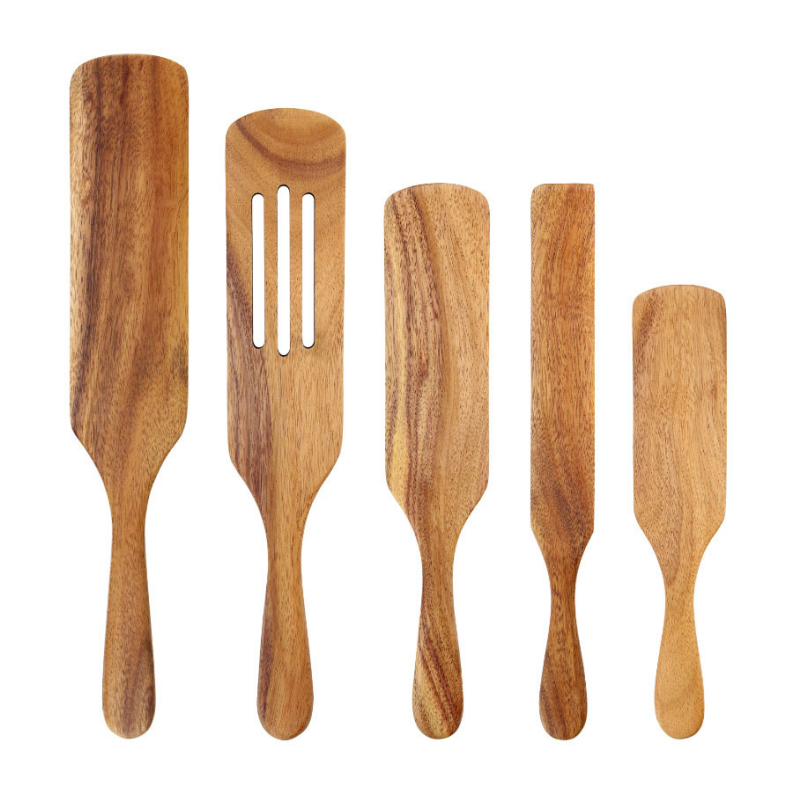
The CNC programs, the sanding jigs, and the finishing fixtures for the new utensil geometry. This is the layer that appears as “mold fee” on the buyer-facing quote. For a fully new geometry -a 5-piece acacia spurtle set with a custom handle profile, for example -this layer is meaningful. For a standardized geometry drawn from the supplier’s existing catalog, this layer is meaningfully smaller because the CNC programs and the sanding jigs can often be reused.
2.2 Layer 2 – Sampling rework rounds
The cost of producing and shipping multiple sample rounds to lock the geometry, the finish, the laser-engraving position, and the packaging structure. Bamboo and acacia sampling typically runs two to four rounds, and each round carries a sample production cost plus a sample shipping cost that buyers who benchmark against plastic OEM systematically miss.
2.3 Layer 3 – Packaging tooling
The inner-box tooling, the master-carton tooling, and the graphic printing plates. New brand buyers frequently budget only the inner-box tooling and miss the master-carton tooling, which is a separate fixture set sized to the retailer’s inbound logistics specification. The graphic printing plates are also a separate line item, and they scale with the SKU count in the product family.
2.4 Layer 4 – Laser-engraving fixtures
The fixture that holds the utensil in position during logo laser-engraving. For a logo placed in a standardized position on the handle, this fixture can often be reused from the supplier’s existing fixture library. For a logo requiring a non-standard position or a non-standard engraving depth, the fixture is custom and adds to the cost.
2.5 Layer 5 – Inter-batch tooling modification
The cost of modifying the tooling between production batches as the geometry is fine-tuned based on retail feedback, as the laser-engraving depth is adjusted, or as the packaging structure is changed to match a new retailer’s shelf specification. This layer is the least visible in buyer-facing quotes because it is recurring rather than upfront, but it is the layer that experienced buyers negotiate explicitly.
3. The five hidden cost layers -a line-item audit
The audit table below organizes the five layers from H2 2 into a line-item format. The “What Was Missed” column is the focus of the audit -it captures the line items that a single-line “mold fee” quote does not surface.
| Layer | Invoice line | What was missed | How to audit |
|---|---|---|---|
| 1 | Geometry-specific tooling (CNC + sanding jigs + finishing fixtures) | Amortization horizon assumption (tooling life vs batch count) | Confirm tooling life in cycles, not in years |
| 2 | Sampling rework rounds (2-4 typical) | Sample shipping cost and rework round budget | Confirm round-by-round budget, not single-sample cost |
| 3 | Packaging tooling (inner box + master carton + printing plates) | Master carton tooling and graphic printing plates | Confirm each packaging fixture as a separate line item |
| 4 | Laser-engraving fixture | Non-standard engraving position or depth | Confirm fixture reuse vs custom per SKU |
| 5 | Inter-batch tooling modification | Modification frequency in the first three batches | Reserve a modification budget from project start |
The five rows of this table are the layer-by-layer audit. A buyer who walks through each row with the supplier before signing the mold fee quote surfaces the under-budgeted layers before they become margin leakage in the first batch.
4. How bamboo tooling compares to plastic mold cost
The cross-category audit below compares bamboo kitchen utensil tooling to plastic OEM mold cost across four real dimensions. This is not a decision matrix -it is a forensic comparison that surfaces where the bamboo cost structure diverges from the plastic baseline that most new buyers bring to the table.
4.1 Tooling material and life
Plastic OEM uses steel injection molds that run for many production cycles with stable dimensional output. Bamboo and acacia tooling uses CNC programs, sanding jigs, and finishing fixtures that degrade differently because the natural-fiber material variability forces geometry re-calibration after several production cycles. The tooling material cost is lower for bamboo, but the tooling life assumption that the supplier uses to amortize the cost is also lower.
4.2 Material waste at press
Plastic molded parts come out of the mold close to net shape. Bamboo and acacia press outputs lose material to grain-direction trimming, moisture-content adjustment, and surface-finish sanding. The waste profile of bamboo and acacia tooling is higher than plastic, and the waste is harder to model because it depends on the bamboo lot rather than the machine settings.
4.3 Sampling rework frequency
Plastic sampling typically runs one to two rounds. Bamboo and acacia sampling typically runs two to four rounds, because the grain direction, the moisture content at pressing, and the sanding tolerance stack introduce variability that plastic and metal do not. The sampling rework frequency is the single largest difference between the bamboo and plastic mental models for OEM buyers.
4.4 Certification and chain-of-custody overhead
Plastic OEM has well-known regulatory paths -FDA, EU food contact, LFGB. Bamboo OEM has those same paths plus the FSC chain-of-custody certification, which applies to the material itself rather than to the finished product. The FSC chain-of-custody cost is amortized across the supplier’s overall bamboo volume, but it is a real cost line that plastic OEM buyers do not face.
The forensic comparison shows that bamboo OEM tooling is not simply “cheaper plastic OEM tooling.” The two cost structures are different in kind, and a buyer who models bamboo OEM as a cheaper version of plastic OEM will systematically under-budget.
5. The sampling loop that doubles your mold investment
The sampling rework loop is the single most under-modeled layer in bamboo utensil mold fee estimation. The reason is that the loop compounds. Each round produces information that triggers another round, and the cumulative cost of three or four rounds can approach the cost of the geometry-specific tooling itself.
A representative sampling loop for a fully new bamboo utensil geometry runs as follows. The first sample confirms geometry feasibility and grain behavior. The second sample corrects the issues found in the first -typically handle thickness, sanding finish, or laser-engraving depth. The third sample aligns the packaging structure with retail shelf dimensions. The fourth sample, when needed, locks the final color and finish specification.
Each round carries a sample production cost (materials, machine time, finishing labor) plus a sample shipping cost (the volumetric weight of bamboo utensils makes international shipping non-trivial). The cumulative cost of three rounds is meaningfully higher than three times the single-sample cost, because each round also triggers supplier-side engineering review time that the supplier typically does not itemize separately but does include in the per-round cost.
The compounding effect is what makes the sampling loop the layer that “effectively doubles the mold investment before the first batch ships,” as noted in the TL;DR above. A buyer who budgets one sample round at the single-sample cost will under-budget the sampling layer by a factor that approaches the mold fee line itself.
6. What experienced buyers negotiate (that new buyers don’t)
Experienced bamboo kitchenware buyers treat the mold fee quote as a starting point for negotiation rather than as a final figure. Five negotiation surfaces are consistently available, and most new buyers do not touch any of them.
Surface 1 – Tooling life assumption. The default tooling life assumption that the supplier uses to amortize the geometry-specific tooling is often conservative for the supplier and unfavorable for the buyer. A longer assumed tooling life extends the amortization horizon and lowers the per-unit allocation. The negotiation is whether the supplier is willing to commit to a tooling life in production cycles rather than in years, which produces a more accurate amortization.
Surface 2 – Amortization horizon extension. The amortization horizon determines how many production cycles the buyer has to recoup the tooling investment. A longer horizon lowers the per-batch allocation but increases the buyer’s exposure if the volume forecast falls short. The negotiation is whether the buyer can lock a longer horizon in exchange for a minimum-volume commitment.
Surface 3 – Modification budget pre-allocation. The inter-batch tooling modification layer is a recurring cost that new buyers typically do not budget at all. Experienced buyers negotiate a modification budget pre-allocation -a fixed number of modification rounds included in the project scope -which prevents the modification cost from being absorbed by the per-unit margin in later batches.
Surface 4 – Sampling round budget cap. The sampling rework rounds are quoted as single rounds in most first-pass quotes. Experienced buyers negotiate a sampling round budget cap -a fixed number of rounds included in the project scope -which prevents the sampling loop from expanding without a corresponding cost discussion.
Surface 5 – Packaging scope lock-in. The packaging tooling scope is often ambiguous in first-pass quotes, with the inner box, the master carton, and the printing plates listed as a single combined line. Experienced buyers negotiate a packaging scope lock-in that explicitly separates each fixture and assigns a fixed cost to each.
The five surfaces above are not the only negotiation points, but they are the five that experienced bamboo kitchenware buyers consistently raise. New buyers who raise even one of these surfaces in the first negotiation typically see a meaningful improvement in the mold fee line item itself.
7. A mold fee audit checklist before you sign the quote
The audit checklist below is the practical distillation of the seven sections above. Walking through it with the supplier before signing the mold fee quote is the most reliable way to surface the under-budgeted layers before they become margin leakage.
- ☐ Item 1 – Geometry scope. Confirm whether the geometry is fully new or drawn from the supplier’s existing catalog. Reusable geometry reduces Layer 1 cost.
- ☐ Item 2 – Tooling life in cycles. Confirm the tooling life assumption in production cycles, not in years. A longer cycle assumption extends the amortization horizon.
- ☐ Item 3 – Sampling round budget. Confirm a fixed sampling round budget included in the project scope, not a single-sample cost.
- ☐ Item 4 – Packaging fixture scope. Confirm inner box, master carton, and printing plates as separate line items.
- ☐ Item 5 – Laser fixture reuse. Confirm whether the laser-engraving fixture is reused from the supplier’s library or built custom for this SKU.
- ☐ Item 6 – Modification budget. Reserve a modification budget for inter-batch changes in the first three production batches.
- ☐ Item 7 – FSC chain-of-custody line. Confirm the FSC chain-of-custody cost as a separate line item, not bundled into per-unit pricing.
Each checked item on this list represents a layer of the audit that the single-line “mold fee” quote does not surface. Walking through all seven with the supplier before signing produces a quote that is materially different from the first-pass quote, and the difference is exactly the under-budgeting the audit is designed to prevent.
Frequently Asked Questions
How can a mold fee quote look reasonable but still under-fund a bamboo utensil project?
The visible mold fee line item is typically accurate. The under-funding comes from the four layers that the single-line quote does not surface: sampling rework rounds, packaging tooling, laser-engraving fixtures, and inter-batch tooling modification. A complete audit surfaces all five layers before the project starts.
What is the most commonly missed hidden cost layer?
Inter-batch tooling modification. New buyers budget the upfront mold fee and the sampling round but rarely budget the modification layer, which is recurring rather than upfront. The modification layer is the layer that experienced buyers negotiate explicitly because it is the layer that compounds over the first three batches.
Why do plastic OEM mental models fail in bamboo sourcing?
Plastic OEM has a single capital line item -the steel mold -with a long, predictable tooling life. Bamboo OEM has five cost layers with different timing profiles, a shorter tooling life, and additional FSC chain-of-custody overhead. A buyer who models bamboo OEM as a cheaper plastic OEM will miss four of the five layers.
How much does sampling rework add to mold investment?
The sampling loop compounds across rounds. For a fully new geometry, three or four sampling rounds can approach the cost of the geometry-specific tooling itself, effectively doubling the mold investment before the first batch ships. The sampling layer is the most under-modeled in first-time bamboo OEM projects.
What is the single most important line item to audit in a bamboo mold fee quote?
The tooling life assumption. The tooling life in production cycles determines the amortization horizon, which determines the per-unit allocation, which determines the per-batch margin. A buyer who walks through the tooling life assumption with the supplier before signing typically sees the largest single improvement in the quote.
About the Yawen mold-development process
This article reflects the mold-development and sampling process used by our team at Ningbo Yawen. We are a bamboo and wooden kitchenware supplier with more than two decades of project history serving brand buyers across Europe, the US, Japan, South Korea, Australia, and Brazil. Our in-house design department operates from Ningbo and our Paris design office (established in 2007), and we maintain an FSC-certified bamboo and wood supply chain across our more than 80-person professional team. For inquiries related to the mold-fee estimation framework discussed in this article, visit our company background or contact our sourcing team directly.
Referenced Resources & Products
References & Standards
Post time: Jul-24-2026