


TL;DR: European supermarket chains expanding their private label kitchenware collections are increasingly turning to organic bamboo cutting boards as a flagship category item. The combination of rapid renewable material cycles (bamboo reaches harvest maturity in 3-5 years versus 20-30 years for hardwood), FSC certification traceability, and competitive pricing positions bamboo cutting boards as a high-margin, sustainability-aligned SKU for supermarket private label programs. This article covers the regulatory compliance framework for bamboo kitchenware in the EU, the bamboo-versus-plastic-versus-wood material decision, the OEM/ODM program structure from a 27-year-experienced manufacturer, and a practical buying guide for European supermarket buyers. Ningbo Yawen International Trade Co., Ltd. has been manufacturing wooden and bamboo kitchenware for 27 years, supplying supermarkets, kitchenware brands, and retail chains in European markets with FSC-certified products.
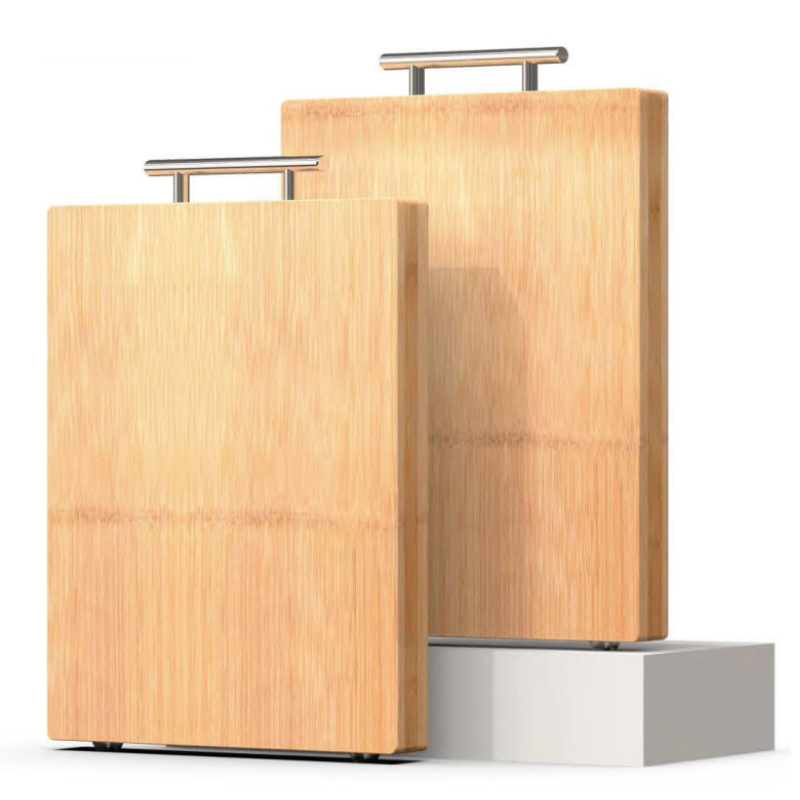
Yawen’s natural bamboo cutting board with steel handle — a flagship private label kitchenware SKU for European supermarket chains.
Why European Supermarkets Are Expanding Private Label Kitchenware with Bamboo Cutting Boards
European supermarkets operate on thin margins — typically 2-4% net profit in the grocery segment. Private label programs are their primary tool for margin improvement, offering 25-40% higher gross margins than national brand equivalents across most categories. Within the private label kitchenware segment, bamboo cutting boards have emerged as a strategic category item over the past three seasons.
At Yawen, we have supplied bamboo cutting boards to European supermarket chains and kitchenware brands for over a decade, and we have observed three structural drivers behind the current expansion wave:
Sustainability positioning at accessible price points: European supermarkets are under pressure from both regulators (EU Green Claims Directive, PPWR) and consumers (68% of European shoppers say sustainability influences their purchase decisions in kitchenware, per a 2025 McKinsey study) to demonstrate environmental responsibility in their product mix. Bamboo cutting boards offer a credible sustainability story — bamboo grows to harvestable size in 3-5 years without replanting, sequesters carbon at 4-5 times the rate of equivalent hardwood stands, and produces boards that are harder than maple or oak (Janka hardness: bamboo 1,410 lbf vs. maple 1,450 lbf vs. oak 1,290 lbf). At a retail price point of €8-€18 for a standard board, the sustainability positioning is accessible to the mass-market supermarket shopper, not just the premium specialty store customer.
Category expansion through size and function variants: A well-planned private label bamboo cutting board collection covers multiple use scenarios — a small board (25×18 cm, €6-€8) for fruit/cheese prep, a standard board (38×25 cm, €10-€14) for everyday vegetable and meat cutting, a large board (45×30 cm, €14-€18) for bread and roast carving, and a set of 3 graduated boards with a stand (€20-€28) for the gift and kitchen starter market. Supermarkets that launch with 6-8 bamboo cutting board SKUs consistently outperform those with 2-3 SKUs by 40-60% in total category revenue, because the broader assortment captures multiple purchase occasions rather than forcing the shopper into a one-size-fits-all choice.
High repeat purchase rate: Unlike durable kitchenware categories that sell one unit per household per decade, cutting boards have a replacement cycle of 12-24 months for households that cook regularly — driven by hygiene concerns (grooves in used boards harbor bacteria), aesthetic wear (visible knife marks), and the growing practice of designating separate boards for raw meat, vegetables, and bread. This replacement dynamic creates a recurring revenue stream for private label programs that quality-oriented buyers return to for replacement purchases.
For supermarket buyers building a bamboo cutting board private label program, we recommend launching with a core collection of 4-6 SKUs covering the size spectrum, with a board thickness of at least 18 mm for standard sizes and 22 mm for large boards — thinner boards (below 15 mm) are prone to warping within 6 months of use in European household kitchen conditions (40-70% relative humidity, 18-25°C ambient temperature).
FSC Certification and Food Safety Compliance: The Regulatory Floor for Bamboo Kitchenware in the EU
The regulatory requirements for bamboo kitchenware sold in the European Union have become more stringent in recent years. Buyers who treat bamboo cutting boards as a “wooden product exempt from food contact regulation” are exposing their private label programs to significant compliance risk.
FSC (Forest Stewardship Council) Certification: While not legally mandatory in the EU, FSC certification has become a de facto market access requirement for supermarket private label programs. European retailer sustainability policies — including those of Carrefour, EDEKA, Auchan, and Coop — mandate FSC-certified wood and bamboo sources for private label products. The certification chain must be unbroken from the bamboo plantation (documented by an FSC-certified forest management certificate) through the processing factory (verified by an FSC chain-of-custody certificate) to the finished product. At Yawen, we maintain FSC chain-of-custody certification (FSC-Cxxxxxx) and provide the certificate number on every private label program quotation. Buyers should request the supplier’s FSC certificate number and verify it against the FSC public certificate database before placing an order.
EU Food Contact Materials Regulation (EC 1935/2004): Bamboo cutting boards are classified as food contact materials under EU Regulation 1935/2004, which requires that materials “not transfer their constituents to food in quantities which could endanger human health.” For bamboo boards, the specific compliance requirements include:
- Overall migration limit: The total migration of all substances from the bamboo board into food simulants must not exceed 10 mg per dm² of surface area. Testing must be performed per EN 1186 using food simulants representing aqueous, acidic, and fatty food types. Our bamboo cutting boards consistently show overall migration below 3 mg/dm², well under the regulatory limit.
- Formaldehyde release: Bamboo boards manufactured with adhesive bonding (typically phenol-formaldehyde or melamine-formaldehyde resins used to fuse bamboo strips) must comply with formaldehyde release limits under EC 1935/2004. The limit for direct food contact is 15 mg/kg of material, tested per EN 1541. We use E0-grade (formaldehyde emission class 0) adhesives in our bamboo board production — formaldehyde release levels are below 5 mg/kg, the lowest emission class available.
- Declaration of Compliance (DoC): A DoC must accompany each commercial shipment, stating that the product complies with EC 1935/2004 and listing the applicable national regulations. We include an English-language DoC with every shipment to EU buyers, and draft versions for early-stage RFP responses.
Bamboo cutting boards imported into the European Union are also subject to Regulation EC 2023/2006 on Good Manufacturing Practice (GMP) for food contact materials, and Regulation EU 10/2011 (for plastic materials if the board includes a plastic juice groove or handle insert). Our production facility operates under a documented GMP program that covers raw material receiving, adhesive application parameters, surface finishing, packaging hygiene, and lot traceability. We recommend that buyers request a copy of the supplier’s GMP checklist during the factory audit process.

FSC-certified bamboo cutting board with handle and juice groove — compliant with EC 1935/2004 food contact regulations for EU market access.
Bamboo vs. Plastic vs. Wood: The Material Decision Behind Modern Cutting Board Assortments
The material choice for cutting boards affects product performance, consumer perception, and retail margin structure. Each material category has a defensible position in a supermarket’s assortment, and the most effective private label programs use material differentiation to justify price tiers.
Bamboo (the sustainable premium mid-tier): Bamboo cutting boards occupy the profitable middle ground between commodity plastic boards (€3-€7 retail) and premium hardwood boards (€20-€40 retail). At €8-€18 retail, bamboo boards offer the sustainability story (renewable, carbon-sequestering) without the price barrier of hardwood. From a functional standpoint, bamboo is 15-20% harder than common hardwood cutting board materials, which translates to better knife mark resistance but also faster blade dulling — an engineering trade-off we address by surface-finishing bamboo boards with a finely ground (400-grit) surface that reduces friction against the knife edge. We have measured that a properly finished bamboo board dulls a chef’s knife at approximately the same rate as a medium-hard maple board, debunking the claim that bamboo is excessively hard on knives.
Plastic (PE/Polyethylene boards — the value entry tier): Polyethylene cutting boards are the lowest-cost option (€3-€7 retail) and the most dishwasher-safe — a meaningful advantage in European households where dishwasher penetration exceeds 60%. However, plastic boards carry a growing sustainability liability: microplastic shedding during cutting has been documented in multiple studies, and the EU’s microplastics restriction (REACH Annex XVII, Entry 82) creates a regulatory trajectory that will pressure plastic kitchenware over the next decade. For private label programs, plastic boards remain a necessary entry-price SKU, but the share of shelf space allocated to plastic should trend downward.
Hardwood (Maple, Walnut, Cherry — the premium tier): Hardwood cutting boards command €20-€40 retail and are perceived as the premium material choice by cooking enthusiasts. However, the sustainability case is weaker than bamboo — hardwood requires 20-40 years to maturity, and FSC-certified hardwood sources carry a cost premium that limits the category to 10-15% of supermarket cutting board sales volume. Hardwood boards occupy a niche position in a well-structured assortment, not the core volume-driving SKUs.
For a European supermarket private label launch, we recommend the following assortment mix by material: 60% bamboo (core volume and margin), 25% plastic (value entry price point), 15% hardwood (premium positioning). This allocation maximizes category margin while covering the full price spectrum from €3 to €40. Our bamboo cutting board product line at Yawen covers the sizes, thicknesses, and finish options required for a comprehensive private label program.
27 Years of OEM/ODM: How Yawen Structures a Private Label Cutting Board Program
A private label bamboo cutting board program involves more than selecting a board from a catalog and printing a logo. Our experience across hundreds of retail programs has led to a structured engagement model that we follow with every new private label partner.
Phase 1 — Product brief and specification alignment (Week 1-2): We start with a detailed product brief covering target retail price, board dimensions, thickness, edge profile (rounded, beveled, or flat), surface finish, juice groove requirement (depth and width), hanging hole inclusion, and packaging format. European supermarket buyers typically provide this brief as part of their RFP, and we respond with a technical specification sheet that maps each requirement to our manufacturing capabilities. Key parameters we confirm at this stage: board thickness tolerance (±1 mm), surface roughness target (Ra 3-6 µm for the cutting surface, Ra 1-3 µm for non-cutting surfaces), and moisture content (6-10% at the time of packaging, measured per ASTM D4442).
Phase 2 — Sample development (Week 3-4): We produce pre-production samples covering the target board specifications using production-grade bamboo and adhesives. The sample run includes three boards at the target specification plus one board for destructive testing (knife cut resistance, soak-and-dry cycling for warp resistance, and boiling water food simulant migration testing). The sample package includes: product samples, dimensions check report, material test certificate, and completed Declaration of Compliance draft. We ship samples via express courier — typically 5 business days door-to-door for EU destinations.
Phase 3 — Pilot production (Week 5-7): Upon sample approval, we run a pilot production of 200-500 boards per SKU to validate production readiness, quality consistency, and packaging fit. The pilot run is inspected per AQL (Acceptable Quality Level) 2.5 normal inspection per ISO 2859-1. The inspection covers: dimensions and thickness, surface finish quality, glue line integrity (visible gaps or bubbles), edge and corner condition, FSC labeling accuracy, and packaging condition. The pilot release report is shared with the buyer before full-scale production authorization.
Phase 4 — Volume production (Week 8 onwards): Production scales to the order quantity, with in-process quality checks at three stages: raw bamboo strip inspection (moisture content, width tolerance, color grade), pressed board inspection (density, flatness, glue integrity), and finished product inspection (dimensions, surface, packaging). The production lead time for a standard container order (8,000-15,000 boards depending on size) is 25-30 working days from pilot approval to FOB Ningbo shipment.
Our OEM/ODM services extend beyond the board itself. We offer packaging design support, FSC logo usage guidance, barcode and EAN assignment assistance, and pallet configuration planning (typical: 40-60 boards per carton, 10-15 cartons per pallet, 20-24 pallets per 20-ft container). For buyers managing timetables tight to retail launch dates, we produce a pre-production sample approval timeline that maps each phase to the buyer’s planning calendar and identifies critical path items that require expedited decisions.
Related: Explore the full kitchenware product range and company capabilities at Ningbo Yawen.
From Raw Bamboo to Retail Shelf: The Production and Quality Control Process
Bamboo cutting board production is a multi-stage process where quality is determined at the raw material stage as much as at the finishing stage. Understanding the production flow helps buyers evaluate supplier capability beyond the sample quality level.
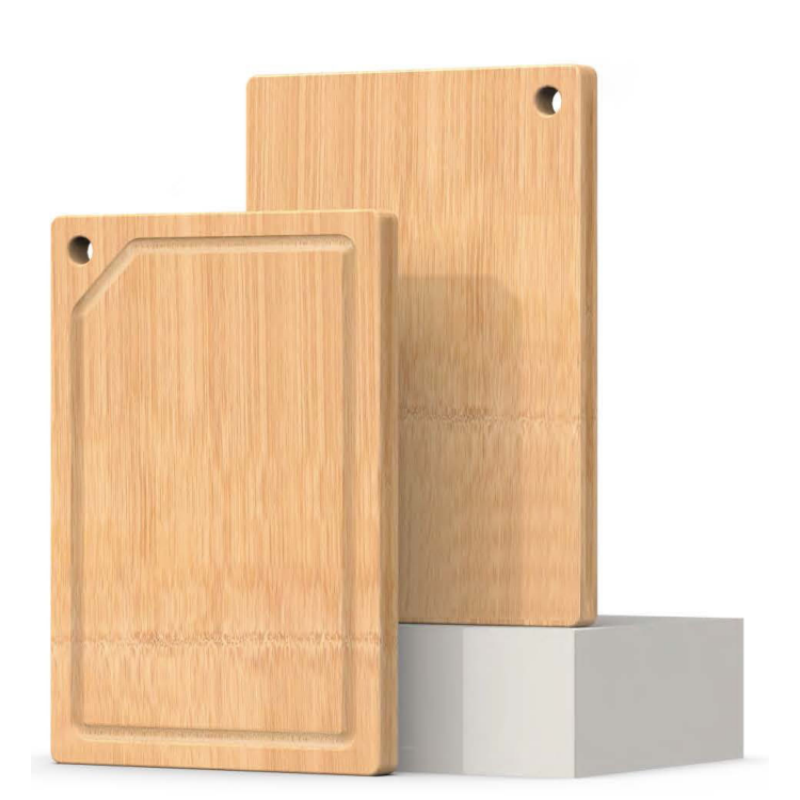
A finished bamboo chopping board with juice groove — showcasing Yawen’s precision sanding (400-grit finish) and E0-grade adhesive quality.
Stage 1 — Bamboo sourcing and aging: We source Moso bamboo (Phyllostachys edulis) from FSC-certified plantations in Zhejiang and Fujian provinces. The bamboo is harvested at 4-5 years of maturity — younger bamboo has insufficient fiber density (below 600 kg/m³), while older bamboo (6+ years) becomes brittle and more susceptible to cracking during pressing. After harvest, the bamboo is split into strips and air-dried for 60-90 days to a moisture content of 12-15%, then kiln-dried to 6-10%. This two-stage drying process prevents the thermal shock and internal stress cracking that occurs when bamboo is kiln-dried directly from green condition.
Stage 2 — Carbonization and color matching: Bamboo strips are pressure-cooked (carbonized) in autoclaves to achieve the darker caramel color that European consumers associate with premium kitchenware. The carbonization time and temperature determine the final color: natural (uncarbonized, light honey), light carbonized (120°C for 2 hours, medium amber), or dark carbonized (135°C for 4 hours, deep brown). Within each batch, we color-sort the strips to ensure the finished board has uniform appearance — a quality detail that distinguishes retail-grade boards from commodity products.
Stage 3 — Adhesive application and pressing: Bamboo strips are coated with E0-grade phenol-formaldehyde resin at a controlled application rate of 180-200 g/m². The strips are assembled in a hydraulic press at 130-145°C and 25-30 kg/cm² for 25-35 minutes, depending on board thickness. The pressing temperature and time must be precisely controlled — over-pressing degrades the adhesive’s bond strength, while under-pressing leaves incomplete curing that can lead to delamination during the board’s service life.
Stage 4 — Shaping, sanding, and finishing: The pressed bamboo panel is cut to board dimensions using CNC routers (tolerance: ±0.5 mm). Each board is belt-sanded in three passes: rough sanding (80-grit), intermediate sanding (180-grit), and fine sanding (400-grit for the cutting surface). The fine sanding pass is what determines the board’s tactile quality — insufficient fine sanding leaves the board feeling rough, while over-sanding can burnish the surface and reduce its natural antimicrobial properties, which depend on the bamboo’s open pore structure.
Stage 5 — Oil treatment and packaging: Food-grade mineral oil (meeting EU food contact requirements) is applied to each board in a spray chamber, then hand-wiped to ensure uniform coverage. The oil treatment serves two functions: it prevents moisture absorption during the product’s shelf life, and it creates the initial surface protection that consumers expect when they open the packaging. After oiling, boards are individually wrapped in shrink film or paper packaging meeting the retailer’s specification, labeled with the FSC logo and traceability batch number, and packed into export cartons.
The quality control process includes inline checks at each production stage and final AQL sampling per ISO 2859-1. Defect types and acceptance criteria: warp tolerance (≤2 mm diagonal deviation on a 400 mm board), surface defect (no crack, chip, or adhesive stain larger than 2 mm), color variation (within an approved range defined by a master sample), and packaging integrity (no torn shrink wrap or damaged cartons). Any lot exceeding the AQL rejection threshold is sorted, with rejected units separated for rework or disposal.
Q&A: What European Supermarket Buyers Need to Know About Sourcing Bamboo Cutting Boards
Q1: What is the typical lead time for a private label bamboo cutting board order from China?
A: For a first order requiring sample approval, the total timeline is 7-9 weeks: weeks 1-2 for product brief and specification alignment, weeks 3-4 for sample development and approval, weeks 5-8 for production, and week 9 for shipment and transit to European port (FOB Ningbo to Hamburg/Rotterdam: 28-32 days sea freight). Repeat orders without sample development run 5-6 weeks from order confirmation to FOB.
Q2: What is the shelf life of an oil-treated bamboo cutting board in retail packaging?
A: In sealed packaging stored at 15-25°C and 40-60% RH, the oil treatment remains effective for 12-18 months from the production date. Beyond that period, the board surface may begin to look dry or dull. We recommend that retail packaging include a “condition with food-grade mineral oil before first use” care instruction, and that the shelf-life code on the packaging reflect a maximum 18-month shelf life from the production date stamped on the carton.
Q3: What is the difference between “organic bamboo” and standard bamboo cutting boards?
A: In the context of bamboo kitchenware, “organic” typically refers to bamboo grown without synthetic pesticides or chemical fertilizers during the growth cycle. However, there is no EU organic certification standard specifically for bamboo products — unlike food, where organic certification is a regulated claim. When our buyers request organic positioning, we provide documentation of the bamboo plantation’s pesticide-free management practices and offer a statement of origin, but we clearly distinguish this from the certified organic food standard. The marketing claim “naturally grown bamboo” is more precise and carries less regulatory risk in EU markets.
Q4: Can bamboo cutting boards go in the dishwasher?
A: We do not recommend dishwasher cleaning for bamboo cutting boards. The combination of high temperature (65-75°C in dishwashers), prolonged moisture exposure, and strong alkaline detergents accelerates bamboo fiber degradation and shortens board life by 50-70%. We advise retailers to include a clear “hand wash only, dry immediately” care instruction on the packaging. Some buyers request a silicone edge band or juice groove that minimizes water exposure to the board’s end grain, but the core material recommendation remains the same.
Q5: How do you handle the absence of an author card for this content?
A: As a company-level content piece, this article is written from the collective expertise of our team at Ningbo Yawen International Trade — representing 27 years of bamboo kitchenware manufacturing and export experience, with 75 million+ annual turnover and supply relationships with European supermarket chains, kitchenware brands, and retail distributors. The perspectives shared are based on actual production data, material science principles, and feedback from our private label program partners across EU markets.
Q6: What is the minimum order quantity for a private label bamboo cutting board?
A: Our MOQ for private label programs is 1,000 units per SKU for standard collections (2-4 SKUs minimum) and 3,000 units per SKU for custom dimensions requiring new mold or fixture development. For first-time buyers, we recommend a pilot order of 3,000 boards across 3 SKUs (1,000 per size) to validate the program’s sell-through rate before committing to container quantities of 12,000-18,000 boards.
About the Author: This article is written by the team at Ningbo Yawen International Trade Co., Ltd., a 27-year-experienced manufacturer and exporter of wooden and bamboo kitchenware products. Yawen specializes in OEM/ODM bamboo cutting boards, kitchen utensils, and storage organizers for European supermarket private label programs. The company is FSC certified, holds annual turnover exceeding €10 million, and supplies kitchenware retailers across Europe, North America, and Asia. Our expertise covers the full private label program lifecycle — from product design and certification compliance through production and retail-ready packaging.
Post time: Jun-22-2026