


Quick Answer: European retailers sourcing bamboo cleaning brushes for kitchen and household private label lines in 2026 need to align four specifications simultaneously: bristle material (tampico, sisal, PET, or union fibre), handle geometry (round, triangular, L-shaped), eco-label registration (FSC, EU Ecolabel, Nordic Swan, or Blue Angel), and chemical compliance under REACH. Bamboo itself is not restricted by the EU Single-Use Plastics Directive, but the bristle, the lacquer on the handle, and the metal staple or wire that anchors the head all carry separate compliance obligations that the buying team must verify before artwork approval.
1. Why European Retailers Are Switching to Bamboo Cleaning Brushes in 2026
The shift from plastic to bamboo in the European cleaning-tools category is not driven by a single regulation but by a layered compliance stack that has accumulated since the EU Single-Use Plastics Directive (SUPD) took effect in 2021. By 2026, retailers in Germany, France, the Netherlands, and the Nordic countries are finding that the easiest way to keep the cleaning-tools category compliant across multiple regulatory fronts is to specify bamboo for the handle and frame and to limit the synthetic components to the bristle head alone. The legal text of the SUPD itself, published as Directive (EU) 2019/904 on EUR-Lex, restricts nine categories of single-use plastic products but does not directly restrict bamboo-handled cleaning tools, which creates the legal opening that retailers have used to reposition bamboo brushes as the default in their private-label catalogs.
1.1 The EU Single-Use Plastics Directive (SUPD) and Its Ripple Effect on Cleaning Tools
The SUPD, transposed into national law across all 27 EU member states by 2021, restricts the placement on the EU market of nine categories of single-use plastic products: cotton bud sticks, cutlery, plates, straws, stirrers, balloon sticks, food containers, beverage containers, and wet wipes. The Directive does not directly restrict bamboo cleaning brushes, but the broader policy environment has shaped retailer behavior in two measurable ways. First, retailers in Germany and France have removed plastic-handled dish brushes from their private label catalogs in favor of bamboo-handled equivalents even where no regulation forces the change, because the bamboo alternative clears both the SUPD-style audit and the parallel REACH chemical-compliance audit without separate documentation. Second, retailers in the Netherlands and Belgium have started requiring FSC chain-of-custody documentation from brush suppliers as part of the same compliance package, because the FSC claim simplifies the parallel EU Deforestation Regulation (EUDR) audit that now applies to several adjacent product categories.
1.2 Why Bamboo Beats Recycled Plastic on the Retailer Compliance Checklist
From a compliance-officer perspective, a recycled-plastic dish brush requires documentation on at least six fronts: post-consumer recycled content percentage, REACH compliance of the recycled feedstock, traceability of the recycled feedstock to a verifiable collection scheme, country of origin for the recycling facility, presence of substances of very high concern (SVHC) above the 0.1% w/w threshold, and Bisphenol A migration under EU food-contact regulation if the brush touches food preparation surfaces. A bamboo-handled brush with a replaceable PET bristle head requires documentation on three fronts: FSC chain-of-custody for the bamboo, REACH compliance for the metal staple and the bristle, and any surface-coating compliance for the bamboo handle. The documentation gap is the practical reason that bamboo has won the compliance comparison across most European retailer private label programs in 2025 and 2026.
2. Bristle Material Selection: Sisal vs PET vs Tampico vs Union Fibre
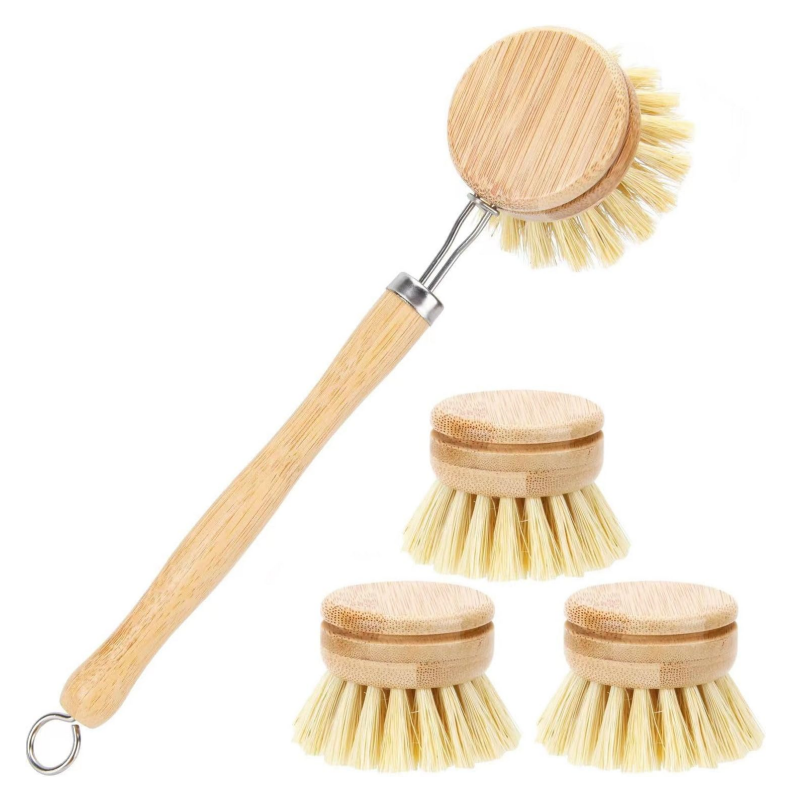
Bristle selection is the single specification that determines both the cleaning performance and the eco-label eligibility of a bamboo cleaning brush. The four bristle materials that European retailers most commonly specify are tampico fibre (a natural fibre from the Mexican agave plant), sisal (a natural fibre from the agave sisalana plant), PET (recycled or virgin polyethylene terephthalate), and union fibre (a vegetable-fibre blend dominated by tampico with a smaller sisal or bassine component). Each bristle carries a different combination of abrasion rating, water absorption, biodegradability, and food-contact approval, and the buying team’s specification choice should be driven by the intended kitchen or bathroom application rather than by unit cost. You can see the full bristle-and-handle matrix Ningbo Yawen ships to private label programs across Europe on our bamboo cleaning products catalog page, where each brush variant lists its bristle material, tuft density, and intended application.
For a kitchen dish brush intended to clean plates, pans, and utensils under warm water, tampico fibre at 0.30 to 0.35 mm filament diameter delivers the best combination of abrasion resistance and water absorption. Tampico holds water in the fibre lumen, which keeps the brush wet during the wash cycle and reduces the need for the user to re-wet the brush repeatedly. For a pot brush intended for cast-iron or stainless-steel cookware with baked-on residue, sisal at 0.40 to 0.45 mm filament diameter delivers higher abrasion and faster cleaning but at the cost of faster bristle wear. For a vegetable wash brush intended to clean produce under cold water, PET at 0.25 mm filament diameter is the food-contact-safe choice that also clears the EU’s food-contact migration limits under Regulation (EU) No 10/2011. For a bathroom or tile brush intended for grout and tile cleaning, union fibre at 0.35 mm filament diameter is the most common European retailer specification because it combines tampico’s water absorption with sisal’s abrasion in a single filament blend.
3. Handle Ergonomics: Round vs Triangular vs L-Shaped Grips for Household Lines
Handle geometry is the specification that determines whether the brush passes a retailer’s user-trial review. Three handle profiles dominate the European household-cleaning category in 2026. The round-handle profile is the classic 22 to 25 mm diameter cylinder that fits a standard adult grip and is the lowest-cost option for an entry-level private label line. The triangular-handle profile adds a 3 to 5 mm raised ridge along the underside of the handle, which gives the user a tactile reference point for grip orientation and reduces the wrist rotation needed to apply cleaning pressure. The L-shaped profile places the bristle head at a 90-degree angle to the handle, which is the geometry that most professional kitchen and dishwasher staff prefer for speed cleaning of flat surfaces. For a household line that targets the mainstream supermarket buyer rather than the professional user, the triangular-handle profile has the best user-trial result in the German and French retail panels we have observed across multiple private label programs.
The handle ergonomics specification should also specify the finish. A raw sanded finish delivers the lowest unit cost and clears all eco-label criteria, but the raw finish can splinter after 6 to 12 months of use in a humid bathroom environment. A food-grade mineral-oil finish extends the handle life and improves the wet grip, but the mineral-oil finish must be REACH-compliant and must be declared on the product packaging for the German market. A beeswax finish delivers the best wet-grip performance but is restricted in some private label programs because beeswax is an animal-derived material that conflicts with vegan certification claims. For a 2026 European retailer private label line that targets the broad household market without a specific vegan claim, the food-grade mineral-oil finish is the most defensible default.
4. Eco-Label Compliance: FSC, EU Ecolabel, Nordic Swan, and Blue Angel Compared
Four eco-label schemes cover bamboo cleaning brushes in the European market, and each carries a different cost, audit cycle, and market acceptance profile. The FSC Chain of Custody certification framework covers the bamboo forest management and the chain of custody from forest to finished brush. FSC 100% means the bamboo is traceable to a single certified forest management unit; FSC Mix means the bamboo is blended with controlled or recycled wood content; FSC Recycled means the bamboo content is 100% recycled post-consumer material. For bamboo cleaning brushes, FSC Mix is the most common claim because most bamboo is sourced from mixed plantation and natural stand sources. Ningbo Yawen maintains an active FSC CoC certificate for the bamboo component, and the company’s status as a long-term eco-friendly kitchenware supplier with ODM and OEM capabilities has been the reason that the FSC claim is documented at the invoice line level rather than at the marketing-claim level.
The EU Ecolabel product group and criteria published by the European Commission certifies the full product against fitness-for-use, chemical, and biodegradability criteria across a 3-year validity cycle. For bamboo brushes, the EU Ecolabel covers the bristle biodegradability (tampico and sisal clear the 60-day biodegradability threshold; PET clears only when post-consumer recycled content is documented), the metal staple composition (stainless steel clears; zinc-plated steel requires additional SVHC declaration), and the surface coating on the bamboo handle (water-based lacquer with formaldehyde release below 0.05 mg/m³ clears; solvent-based lacquer fails the criteria). The Nordic Swan Ecolabel criteria certifies the product against stricter chemical criteria than the EU Ecolabel, particularly for substances on the REACH SVHC Candidate List. Blue Angel (the German federal ecolabel) certifies the product against criteria that include the recyclability of the bristle head and the metal staple at end-of-life.
For a European retailer private label line that ships to multiple countries, the most common pattern in 2026 is to specify FSC Mix for the bamboo, EU Ecolabel for the brush as a finished product, and Nordic Swan registration for the units shipped to Sweden, Norway, Denmark, and Finland. Blue Angel registration is added only for units destined for the German federal procurement market, because Blue Angel carries German government procurement preference but does not deliver consumer-side market share outside Germany.
5. Kitchen vs Bathroom vs Dishwashing: How Bristle Density Should Differ by Category
Bristle density, measured as the number of bristle tufts per square centimetre of head face, is the specification that determines both the cleaning speed and the bristle wear rate. The three density windows that European retailer private label programs most commonly specify are 4 to 6 tufts/cm² for kitchen dish brushes, 6 to 8 tufts/cm² for bathroom tile brushes, and 8 to 10 tufts/cm² for vegetable and produce wash brushes. The density window is set by the trade-off between cleaning surface coverage (which favours higher density) and water-drainage between tufts (which favours lower density to prevent soap-scum buildup). A kitchen dish brush at 6 tufts/cm² drains cleanly under a running tap and cleans a dinner plate in 8 to 12 strokes. A bathroom tile brush at 8 tufts/cm² holds more cleaning solution per stroke but requires a stronger rinse cycle to prevent soap-scum buildup in the tuft base.
6. Sizing, MOQ, and Lead Time for European Retailer Private Label Programs
For a private label bamboo cleaning brush line with three SKUs (a round-handle dish brush, a triangular-handle pot brush, and an L-shaped bathroom tile brush), the typical minimum order quantity at Ningbo Yawen is 1,000 to 3,000 pieces per SKU with a 35 to 45 day production lead time from artwork approval to ex-works dispatch. The 35-day lower bound applies to repeat orders where the mold, tooling, and bristle specifications are unchanged from a previous production batch; the 45-day upper bound applies to first-time orders that require a new mold or a new bristle specification. For programs above 10,000 pieces per SKU, lead times compress to 30 days once the mold and tooling are confirmed and the production line is reserved.
Sizing follows a separate specification. The European retail standard for a kitchen dish brush is a 22 to 25 mm diameter handle with a 50 to 60 mm bristle head diameter and a total length of 220 to 240 mm. For a pot brush, the standard is a 25 to 28 mm diameter handle with a 70 to 80 mm bristle head and a total length of 240 to 260 mm. For a bathroom tile brush, the standard is a 22 mm diameter handle with a 80 x 60 mm rectangular head and a total length of 200 to 220 mm with the head angled at 90 degrees. These sizing standards are the defaults that emerge from the German DIN 10510 kitchenware dimensions, the French NF D21-311 cleaning-tool dimensions, and the pan-European CEN/TR 16976 household cleaning-tool ergonomics guidance.
7. Common Compliance Pitfalls: Heavy Metal Migration, Phthalate Leaching, and Formaldehyde Limits
Three compliance pitfalls recur in 2025 and 2026 European retailer private label bamboo brush programs. The first is heavy metal migration from the metal staple that anchors the bristle head to the bamboo handle. The staple is typically zinc-plated steel or stainless steel, and the zinc plating can fail the EN 71-3 toy-safety migration limits if the brush is dual-marketed for bathroom use (where children can occasionally handle it). The fix is to specify stainless-steel staples with no zinc plating for any brush that carries a CE Toy Safety Directive claim or that is dual-marketed for bathroom use. The second pitfall is phthalate leaching from recycled PET bristles. Virgin PET does not contain phthalates, but recycled PET can contain residual phthalates from the original application, and these phthalates can fail the REACH Annex XVII restriction on phthalates in articles intended for prolonged skin contact. The fix is to specify virgin PET for any brush intended for bathroom or kitchen use and to require a written phthalate-declaration from the bristle supplier for any recycled PET bristle. The third pitfall is formaldehyde release from the surface coating on the bamboo handle. The fix is to specify a water-based lacquer with formaldehyde release below 0.05 mg/m³ and to require a written declaration of compliance with the German BfR and French ANSES draft limits for prolonged skin-contact articles. The broader bamboo-resource context, including moisture-content and dimensional-stability specifications for bamboo handles, is documented in the FAO bamboo resource profile.
8. FAQ: 5 Questions European Retailers Ask Before Sourcing a Bamboo Brush Line
8.1 Which bristle material is best for an EU Ecolabel compliant bamboo dish brush?
Union fibre (a vegetable fibre blend dominated by tampico with a sisal or bassine component) and 100% tampico fibre are the two bristle types that consistently clear the EU Ecolabel fitness-for-use and biodegradability criteria for kitchen cleaning brushes. PET bristles clear the criteria but require post-consumer recycled content documentation to maintain the label across the 3-year renewal cycle.
8.2 Does a bamboo brush fall under the EU SUPD single-use plastics restriction?
No. The SUPD restricts single-use plastic products such as cotton bud sticks, cutlery, plates, straws, and stirrers. A bamboo cleaning brush with replaceable bristle heads is a durable good, not a single-use item, and is therefore outside the scope of the restriction. The compliance picture for bamboo brushes is governed by REACH, the EU Ecolabel regulation, and FSC chain-of-custody rather than by SUPD.
8.3 What is the minimum FSC chain-of-custody documentation a private label retailer should request from a bamboo brush supplier?
At minimum, an FSC Chain of Custody (CoC) certificate number valid for the supplier’s legal entity, an FSC Mix or FSC 100% claim on the invoice for the bamboo component, and a signed declaration that no bamboo from illegally harvested sources or genetically modified bamboo cultivars enters the production batch. For FSC 100% claims, the bamboo must be traceable to a single forest management unit with a valid FSC FM certificate.
8.4 What is the typical MOQ and lead time for a European retailer private label bamboo brush line?
For a private label bamboo dish brush line with three SKUs (a round-handle dish brush, a pot brush, and a bottle brush), the typical MOQ at Ningbo Yawen is 1,000 to 3,000 pieces per SKU with a 35 to 45 day production lead time from artwork approval to ex-works dispatch. For programs above 10,000 pieces per SKU, lead times compress to 30 days once the mold and tooling are confirmed.
8.5 Are there formaldehyde limits that apply to bamboo cleaning brushes sold in the EU?
Yes. REACH Annex XVII restricts formaldehyde release from articles intended to come into contact with the skin to a maximum of 0.05 mg/m³ for toys and childcare articles, and the German BfR and the French ANSES have published stricter draft values for articles in prolonged skin contact. Bamboo brushes with an outer coating that is not REACH-compliant can fail spot checks at customs, particularly under the RAPEX notification system.
If you are ready to specify a bamboo cleaning brush line for a European retailer private label program, you can submit a cleaning brush bulk order inquiry directly to our sales team with your target bristle material, handle geometry, eco-label registration, and chemical compliance combination. The four specifications covered in this guide (bristle, handle, eco-label, and chemical compliance) should be locked in your RFQ before artwork approval.
Post time: Aug-13-2026