


Why Bamboo vs Plastic Is the Most Common Distributor Range Decision
The cutting board category is one of the highest-velocity SKUs in the kitchenware aisle, and the choice between bamboo and plastic as the dominant material in the range is a decision that drives roughly 40 to 60 percent of the category revenue for most kitchenware distributors. The decision matters because the two materials occupy different price tiers, appeal to different consumer segments, and generate very different return rates that flow through to the distributor’s net margin. For a distributor choosing which material to anchor the category, the comparison is not about which material is universally better but which material delivers the better return on the shelf space and the warehouse capital.
From our shipment data covering bamboo cutting boards supplied to European, North American, and Oceanian distributors between 2023 and 2026, bamboo has steadily grown from 35 percent of category volume to 52 percent of category volume across the customer base. The growth is driven by three factors: consumer preference shifting toward natural materials, retailer sustainability commitments that favor FSC certified bamboo, and the relative improvement in bamboo manufacturing quality that has closed the historical price gap with mid-range plastic. The result is that distributors who have not yet rebuilt their category around bamboo are losing shelf space to competitors who have.
For distributors evaluating the category, our bamboo cutting board range covers the entry, mid-range, and premium tiers, and the corresponding plastic equivalents in each tier are typically sourced from a different supplier with a different cost structure. The economics of the comparison are therefore not just material-to-material but supplier-to-supplier, and the procurement decision typically considers the unit cost, the return rate, the shelf turnover, and the customer satisfaction data together rather than in isolation. The two dominant sustainability certifications for the bamboo supply chain are FSC (Forest Stewardship Council) for the European market and PEFC (Programme for the Endorsement of Forest Certification) for the broader international market, and the certification documentation is the first specification to verify when comparing bamboo suppliers.
Retail Price Positioning Across the Three Tiers
The retail price positioning for cutting boards follows three tiers in both materials. The entry tier covers boards retailing from USD 5 to 15, the mid-range tier covers USD 15 to 35, and the premium tier covers USD 35 to 80. In each tier, bamboo commands a price premium over plastic, but the size of the premium varies significantly across the tiers and across the retail channels.
At the entry tier, the price gap is the narrowest. Cheap plastic boards retail for USD 5 to 12, and cheap bamboo boards retail for USD 12 to 18. The premium for bamboo at the entry tier is 20 to 40 percent over plastic, and the consumer is choosing between a low-cost utility board and a slightly more expensive natural material board. The entry tier is the most price-sensitive segment, and the conversion from plastic to bamboo at this tier depends heavily on retailer merchandising and consumer education about the longer service life.
At the mid-range tier, the price gap is the widest. Mid-range plastic boards retail for USD 12 to 25, and mid-range bamboo boards retail for USD 22 to 40. The premium for bamboo at the mid-range tier is 50 to 80 percent over plastic, and the consumer is choosing between a familiar plastic board and a more expensive bamboo board that offers a longer service life and a more attractive kitchen display. The mid-range tier is where the category economics work most strongly in favor of bamboo, because the higher unit price combined with the lower return rate delivers the best net margin per unit of shelf space.
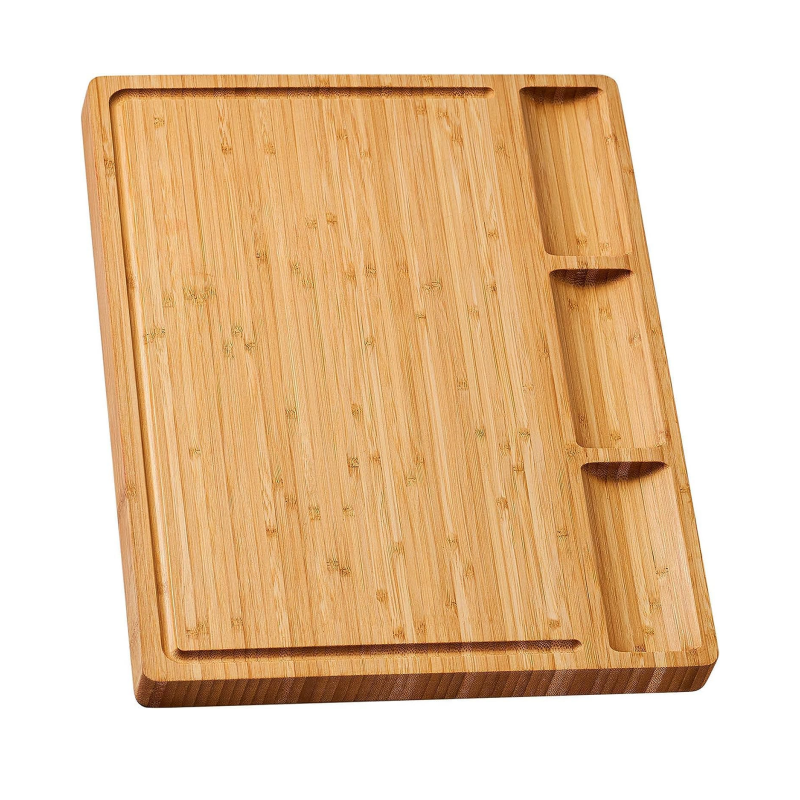
At the premium tier, the price gap narrows again. Premium plastic boards with features like juice grooves and built-in compartments retail for USD 25 to 45, and premium bamboo boards with similar features retail for USD 35 to 65. The premium for bamboo at the premium tier is 30 to 50 percent over plastic, and the consumer is choosing between two high-quality boards where the material is the primary differentiator. Our 3-in-1 bamboo cutting board with juice grooves is the reference SKU at the premium tier, and it competes directly with the equivalent plastic 3-in-1 board from European premium kitchenware brands.
Shelf Life and Service Life Comparison
The shelf life of a cutting board in the consumer’s kitchen is the second economic lever that drives the distributor range decision. A cutting board that lasts longer in the consumer’s kitchen generates fewer repeat purchases per consumer, which reduces the category velocity, but the longer service life also increases the consumer’s willingness to pay a higher initial price, which improves the average selling price for the distributor. The net effect depends on which lever is stronger in the specific retail channel.
For bamboo cutting boards, the typical service life in consumer use is 3 to 5 years with hand-wash care. The longer service life reflects the harder bamboo surface and the denser fiber structure, which resists knife scoring and surface wear. Bamboo boards that are exposed to dishwasher cycles typically crack within 12 to 18 months, so the service life depends heavily on the consumer following the care instructions. For distributors, the dishwasher exposure is the single biggest driver of premature bamboo board failure, and the retail packaging should make the hand-wash-only instruction very clear.
For plastic cutting boards, the typical service life in consumer use is 1.5 to 3 years before knife scoring becomes severe enough to require replacement. Plastic boards show knife grooves within 6 to 12 months of regular use, and these grooves become hygiene concerns that trigger consumer replacement. The replacement cycle is shorter than bamboo, which generates more frequent repeat purchases, but the consumer’s perception of the plastic board as a lower-quality item limits the price they are willing to pay for each replacement. The food contact safety standards for both materials are published by the U.S. Food and Drug Administration for the North American market and the equivalent European food contact framework for the EU market, and both materials require documented compliance for retail distribution.
For distributors, the service life difference means that bamboo generates a higher average revenue per consumer over a 5-year period, while plastic generates a higher purchase frequency. The revenue-per-consumer metric favors bamboo for premium positioning, and the purchase-frequency metric favors plastic for mass-market positioning. The optimal mix depends on the retailer’s brand positioning and the typical customer lifecycle.
Return Rate Data and Net Margin Impact
The return rate is the third economic lever and the one that has the most direct impact on distributor net margin. From aggregated distributor data across the European and North American markets, bamboo cutting boards have a return rate of 1.5 to 2.5 percent, while plastic cutting boards have a return rate of 3.5 to 6.0 percent. The return rate differential is consistent across price tiers and across retail channels, and it is the primary economic argument for distributors to upweight bamboo in their kitchenware range.
The most common return reason for plastic cutting boards is warping and knife scoring. Warping typically occurs when the plastic board is exposed to high dishwasher temperatures or direct sunlight, and the return is triggered when the board no longer sits flat on the counter. Knife scoring is a gradual process that becomes visible to the consumer as deep grooves on the cutting surface, and the return is triggered by hygiene concerns. The combination of these two return reasons accounts for roughly 70 percent of all plastic board returns.
The most common return reason for bamboo cutting boards is cracking due to dishwasher exposure. Bamboo is a natural fiber material, and the rapid temperature changes in a dishwasher cycle cause the fibers to expand and contract at different rates, leading to cracks along the grain. The cracking typically appears within 3 to 6 dishwasher cycles, and the return is triggered by the consumer discovering that the board has split. The second most common return reason is the development of mold on the surface, which occurs when the bamboo is stored in a damp environment without proper drying.
For distributors, the return rate differential translates directly to net margin. A 4 percent return rate on a USD 25 plastic board with a 40 percent gross margin costs the distributor USD 1.00 per unit sold in reverse logistics and lost margin, which is a 10 percent reduction in net margin. A 2 percent return rate on a USD 35 bamboo board with a 50 percent gross margin costs the distributor USD 0.35 per unit sold, which is a 2 percent reduction in net margin. The economic difference is significant, and it compounds across the full category volume. For distributors seeking third-party benchmarking data on the return rate differential between natural fiber and synthetic kitchenware, the Global Standard publishes annual consumer goods return rate reports that include the kitchenware category.
Customer Satisfaction and Repeat Purchase Behavior
Customer satisfaction scores for cutting boards follow a similar pattern to return rates, with bamboo scoring higher than plastic in the entry and mid-range tiers and roughly equal in the premium tier. The satisfaction drivers are different between the two materials, and understanding the drivers helps distributors position the category in the retail merchandising plan.
For bamboo cutting boards, the top three satisfaction drivers are the natural material feel, the longer service life, and the attractive kitchen display. The natural material feel is the strongest driver in the entry and mid-range tiers, and it is the reason consumers are willing to pay the price premium over plastic. The longer service life is the strongest driver in the mid-range and premium tiers, and it is the reason consumers report higher satisfaction with bamboo despite the higher initial price. The attractive kitchen display is the strongest driver in the premium tier, where the bamboo board is used as a serving board for cheese and charcuterie.
For plastic cutting boards, the top three satisfaction drivers are the low price, the dishwasher compatibility, and the color-coding options for HACCP kitchens. The low price is the strongest driver in the entry tier, and it is the reason plastic remains the dominant material in mass-market retail. The dishwasher compatibility is the strongest driver in the mid-range tier, and it is the reason consumers choose plastic over bamboo in households where hand-washing is not preferred. The color-coding options are the strongest driver in commercial and HACCP kitchens, where plastic remains the standard material.
For distributors, the satisfaction data points to two merchandising strategies. The first is to position bamboo in the entry and mid-range tiers with a focus on the natural material feel and the longer service life, and to position plastic in the entry tier with a focus on the low price and the dishwasher compatibility. The second is to position bamboo in the premium tier with a focus on the kitchen display and the serving board use case, and to position plastic in the commercial kitchen channel with a focus on the color-coding and HACCP compliance.
Range Construction Strategy for Distributors
The range construction strategy for a kitchenware distributor depends on the retail channel and the target customer segment. For European and North American retail chains that target the general consumer market, the optimal range typically allocates 55 to 65 percent of category space to bamboo, 25 to 35 percent to plastic, and 10 to 15 percent to specialty materials like wood and composite. For retail chains that target the mass-market and value segment, the optimal allocation is typically 30 to 40 percent bamboo, 50 to 60 percent plastic, and 5 to 10 percent specialty materials.
For distributors serving the commercial kitchen channel, the optimal range allocation is different. Commercial kitchens and HACCP-certified food service operations require color-coded plastic boards for cross-contamination control, and bamboo is not an acceptable substitute in most regulatory frameworks. The commercial channel range is typically 80 to 90 percent plastic with 10 to 20 percent bamboo for front-of-house serving boards in the restaurant and catering segment.
For distributors serving the gift and housewares channel, the optimal range allocation is heavily weighted toward bamboo. Gift and housewares customers buy cutting boards for the kitchen display and the serving use case, and the bamboo material supports both use cases. The gift channel range is typically 75 to 85 percent bamboo and 15 to 25 percent plastic, with the plastic allocated to utility boards that the consumer uses for everyday prep work.
For distributors building the range, the procurement strategy should match the allocation. The bamboo range should be sourced from a supplier with FSC certification and a documented supply chain, and the plastic range should be sourced from a supplier with food-grade certification and documented compliance with FDA and EU food contact regulations. Our bamboo cutting board range covers the entry, mid-range, and premium tiers with FSC certified bamboo and FDA food-safe finishes.
Sustainability and Certification Considerations
Sustainability is a growing driver in the cutting board category, and the certification status of the bamboo supply chain is increasingly important for distributors selling to European retail chains. The two main certifications are FSC (Forest Stewardship Council) and PEFC (Programme for the Endorsement of Forest Certification), with FSC being the more widely recognized certification in the European market. The GRS (Global Recycled Standard) certification is also relevant for distributors selling plastic boards with recycled content, but the recycled content in plastic cutting boards is typically below 50 percent because food contact regulations require virgin material for the cutting surface.
For bamboo cutting boards, the FSC certification covers the bamboo forest management and the chain of custody from the forest to the finished board. Distributors selling to European retail chains typically require FSC certification as a baseline, and the certification documentation must be provided with each shipment. The absence of FSC certification can disqualify a supplier from the European retail chain vendor list, regardless of the product quality or the price. Our certification documentation covers both FSC and GRS for the bamboo and plastic ranges, and the documentation is updated annually. For distributors who need to verify the FSC certification number against the public database, the FSC certificate search portal provides the live certificate status and the certificate expiry date, and the equivalent verification for the recycled content claim is available through the Global Recycled Standard (GRS) public certificate database.
For distributors building the sustainability narrative for the category, the bamboo board offers a stronger story than the plastic board in three ways. First, bamboo is a rapidly renewable resource with a 3 to 5 year harvest cycle compared to 20 to 50 years for hardwood. Second, the carbon footprint of bamboo production is typically 30 to 50 percent lower than plastic production when measured per board. Third, the end-of-life disposal of bamboo is composting-compatible, while plastic cutting boards typically end up in landfill.
Frequently Asked Questions from Kitchenware Distributors
Is bamboo really better than plastic for cutting boards in retail?
For most retail use cases, bamboo is the better choice because it combines a 3 to 5 year service life with a 50 to 70 percent lower return rate compared to plastic. The two exceptions are commercial meat processing and color-coded HACCP kitchens, where food-safe HDPE plastic remains the standard. For general consumer retail, bamboo delivers better customer satisfaction scores, lower return rates, and a higher perceived value that supports the 30 to 50 percent retail price premium over entry-level plastic boards.
What is the typical retail price positioning for bamboo vs plastic cutting boards?
At the entry level, plastic cutting boards retail for USD 5 to 12, mid-range plastic for USD 12 to 25, and premium plastic for USD 25 to 45. Bamboo cutting boards start at USD 15 for a basic model and extend up to USD 80 for a 3-in-1 set with cheese knives. The retail price gap is widest in the mid-range segment where bamboo commands a 30 to 50 percent premium over plastic for comparable board sizes, and narrowest in the entry segment where cheap plastic and cheap bamboo overlap in the USD 12 to 15 band.
What is the typical return rate for bamboo vs plastic cutting boards?
From aggregated distributor data across the European and North American markets, bamboo cutting boards have a return rate of 1.5 to 2.5 percent, while plastic cutting boards have a return rate of 3.5 to 6.0 percent. The most common return reason for plastic is warping and knife scoring, and for bamboo it is cracking due to dishwasher exposure. The return rate differential is the primary economic argument for distributors to upweight bamboo in their kitchenware range, because the lower return rate directly improves net margin and reduces reverse logistics costs.
How long does a bamboo cutting board last compared to plastic?
A well-made bamboo cutting board with hand-wash care lasts 3 to 5 years in typical consumer use, while a mid-range plastic cutting board lasts 1.5 to 3 years before knife scoring becomes severe enough to require replacement. The longer bamboo service life reflects the harder bamboo surface and the denser fiber structure, which resists knife scoring and surface wear. Plastic boards show knife grooves within 6 to 12 months of regular use, and these grooves become hygiene concerns that trigger consumer replacement.
Which is more profitable for kitchenware distributors to stock?
Bamboo is typically more profitable for kitchenware distributors because the higher unit price, lower return rate, and longer replacement cycle combine to deliver a higher net margin per unit of warehouse space. The key economic levers are the 30 to 50 percent retail price premium over plastic, the 50 to 70 percent lower return rate, and the 50 to 100 percent longer shelf turnover cycle. For distributors with constrained warehouse space, bamboo is the higher-velocity SKU.
For kitchenware distributors building or rebuilding the cutting board category, our team can provide the bamboo range catalog, the FSC certification documentation, and the per-shipment pricing for the entry, mid-range, and premium tiers. Reach out through our bamboo cutting board product page with your target retail channel, expected annual volume, and target port to receive a quotation within two business days.
Written by the Ningbo Yawen International Trading editorial team. We are a specialized manufacturer and exporter of bamboo kitchenware based in Ningbo, China, with FSC certified bamboo supply chains and GRS 4.0 certification for recycled content products. Our cutting board, cheese board, and kitchen organizer ranges are sold through kitchenware distributors in 17 countries across Europe, North America, and Oceania. Every product is built to retail specification with FDA food-safe finishes and EU food contact compliance. Browse our full range at yawenkitchen.com.
Post time: Jul-13-2026