


Quick Answer: Japanese home retailers sourcing bamboo laundry baskets for compact living in 2026 need to specify three engineering parameters simultaneously: load capacity (15 to 25 kg for a collapsible X-frame versus 25 to 35 kg for a fixed frame), ventilation design (slatted bamboo base with 8 to 12 slats and 4 to 6 mm gaps versus a solid bottom that traps humidity), and collapsible structure mechanics (X-frame, telescopic, hinged-door, or fold-flat). The basket capacity should be selected by the dwelling type: 40 to 60 litres for a 1K apartment, 60 to 80 litres for a 1R or 1LDK dwelling, and 80 to 100 litres for a family 2LDK or 3LDK dwelling.
1. Why Japanese Home Retailers Need Compact Bamboo Laundry Storage
The Japanese home organization market operates under a footprint constraint that has no equivalent in European or North American retail. The median urban Japanese dwelling in 2026 is a 1K or 1R apartment of 12 to 25 m² total floor area, and the laundry storage unit must fit inside this footprint while still holding 2 to 5 days of clothing for one or two occupants. A bamboo laundry basket that does not collapse to a depth of 6 cm or less when empty cannot be stored in the standard under-bed or closet-corner positions that define the available storage envelope in this dwelling category. The basket capacity, ventilation design, and collapsible mechanism must therefore be specified together as a single engineering package rather than as three independent specifications.
1.1 The 1K/1R/1LDK Apartment Footprint and the Storage Mandate
The Japanese apartment size classification follows the floor-area convention: 1R (one room, typically 10 to 15 m²) is a single room with a separate bath but no bedroom partition; 1K (one room with kitchen, typically 12 to 20 m²) is a single room with a separated kitchen area; 1LDK (one bedroom with living, dining, and kitchen, typically 25 to 40 m²) is the entry-level family apartment. Across all three categories, the laundry storage unit is typically placed in the bathroom (in 1R and small 1K units), in the genkan entry closet (in medium 1K and 1LDK units), or in a dedicated laundry corner adjacent to the kitchen (in larger 1LDK and 2LDK units). The storage envelope at each placement location sets the maximum footprint for the laundry basket: 40 x 40 cm for bathroom placement, 50 x 50 cm for genkan placement, and 60 x 60 cm for dedicated laundry corner placement.
1.2 The MUJI/DAISO Effect on the Japanese Home Organization Market
MUJI (Ryohin Keikaku Co., Ltd.) and DAISO have set the design and price benchmarks for the Japanese home organization market in a way that has no equivalent elsewhere. MUJI’s polypropylene and bamboo laundry basket line, sold across approximately 450 Japan stores and the MUJI global retail channel, defines the consumer expectation for bamboo basket aesthetics, while DAISO’s 300-yen (approximately 2 USD) bamboo-finished hamper line defines the consumer expectation for entry-level price. A private label program that targets the mainstream Japanese retail channel needs to deliver MUJI-grade aesthetics at a wholesale price point that allows retail pricing between the DAISO 300-yen anchor and the MUJI 1,800-yen anchor, with the typical target retail price of 1,200 to 1,500 yen (approximately 8 to 10 USD) for a single-layer hamper and 2,500 to 3,500 yen (approximately 17 to 24 USD) for a 3-layer classification basket. You can review Ningbo Yawen’s full bamboo laundry basket range across single-layer, 2-layer, 3-layer, and collapsible X-frame configurations to see where each SKU sits against the MUJI and DAISO benchmarks.
2. Load Capacity Engineering: Single Layer vs 2-Layer vs 3-Layer vs Collapsible X-Frame
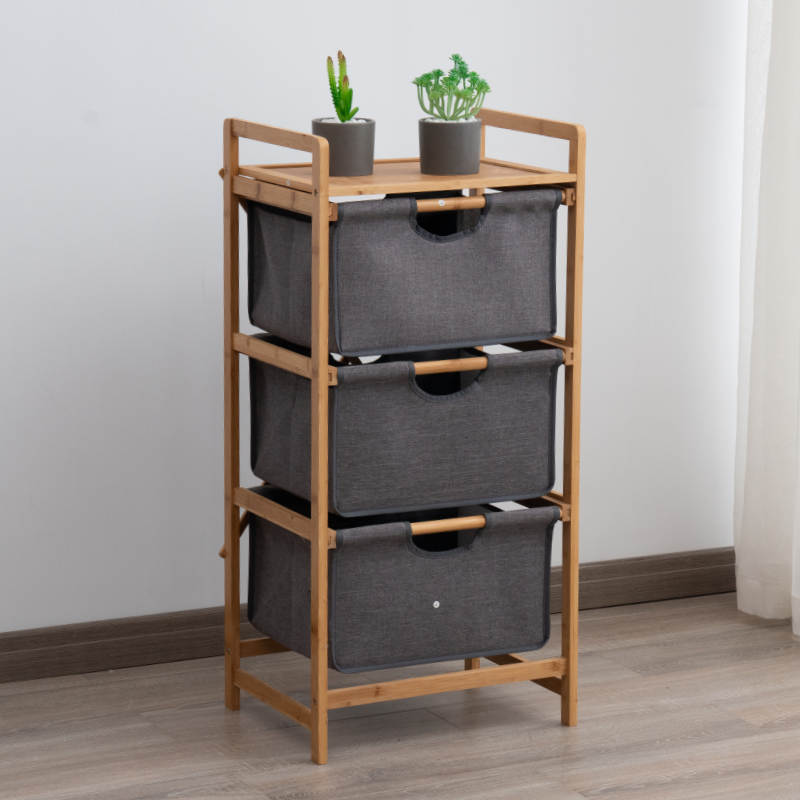
Load capacity is the specification that determines whether the basket passes the Japanese retailer’s standard user-trial review. Four load configurations dominate the 2026 private label market. The single-layer configuration is a single basket with a 40 to 60 litre capacity and a 15 to 20 kg dry-laundry load rating, suited to a single occupant’s 2-day laundry cycle. The 2-layer configuration adds a vertical divider that splits the basket into two compartments, typically a 30 litre compartment for light-coloured clothing and a 30 litre compartment for dark-coloured clothing, with a 20 to 25 kg combined load rating. The 3-layer configuration adds two dividers and creates three compartments for classification by clothing type or washing temperature, with a 25 to 35 kg combined load rating. The collapsible X-frame configuration uses four corner joints and a fabric or Oxford cloth liner to allow the entire basket to fold flat to a depth of 4 to 6 cm when empty, at the cost of a 15 to 25 kg load rating that is lower than the fixed-frame equivalent.
The load capacity is set by two engineering parameters. The first is the bamboo slat thickness. A 5 mm thick bamboo slat with a 50 mm width delivers a 15 to 20 kg load rating per slat; an 8 mm thick bamboo slat with the same width delivers a 25 to 30 kg load rating per slat; a 10 mm thick bamboo slat with the same width delivers a 35 to 40 kg load rating per slat. The second is the joint construction. A glue-and-pin joint (where the bamboo slats are glued and pinned with stainless steel nails) delivers 80% of the load capacity of a through-tenon joint; a through-tenon joint (where the bamboo slats interlock at the corner without metal fasteners) delivers the full rated load but costs 30% more in labor. For a 2026 Japanese retailer private label line that balances load capacity against wholesale price, the 8 mm slat with a glue-and-pin joint is the most common specification. The full capacity-by-footprint table for Ningbo Yawen’s basket line is on the home storage solutions page, where each SKU lists its rated load, footprint, and slat specification.
3. Ventilation Design: Slatted Bamboo Base vs Solid Bottom vs Mesh Insert
Ventilation design is the specification that determines whether the basket prevents the musty-odor problem that is the most common consumer complaint in Japanese humid-summer conditions. Three base designs dominate the market. The slatted bamboo base uses 8 to 12 bamboo slats with 4 to 6 mm gaps between slats to allow air circulation from below; this is the design that delivers the fastest drying time for damp laundry, reducing the typical 36-hour musty-odor threshold in humid conditions to a 12 to 18 hour comfortable-drying window. The solid bamboo base uses a continuous bamboo plywood panel that supports heavier loads but prevents air circulation from below; this is the design that delivers the highest load rating but at the cost of musty-odor risk in humid conditions. The mesh-insert base uses a bamboo perimeter frame with a removable polyester or nylon mesh floor that can be lifted out for cleaning; this is the design that delivers the easiest cleaning cycle but at the cost of a 20 to 30% price premium over the slatted base.
For a 2026 Japanese retailer private label line that targets the mainstream 1K and 1LDK market, the slatted bamboo base is the most defensible default. The slatted base clears the consumer expectation for fast drying in humid conditions without the price premium of the mesh-insert design and without the musty-odor risk of the solid-bottom design. The slat count should be specified at 8 to 12 slats for a 40 to 60 litre basket, 12 to 16 slats for a 60 to 80 litre basket, and 16 to 20 slats for a 80 to 100 litre basket, with the slat gap held at 4 to 6 mm across all sizes. The general framework for bamboo drying and dimensional stability, which sets the moisture-content specification for the slats, is summarized in the FAO bamboo resource profile on bamboo drying and in the International Network for Bamboo and Rattan (INBAR) technical resources.
4. Collapsible Structure Mechanics: X-Frame vs Telescopic vs Hinged-Door vs Fold-Flat
Four collapsible mechanisms are in production across the 2026 Japanese retail market. The X-frame mechanism uses four corner joints and a removable fabric liner; the entire basket folds flat to 4 to 6 cm depth when empty, and the basket can be set up or folded in approximately 10 seconds. The X-frame is the lightest collapsible design (typical empty weight 0.8 to 1.2 kg for a 60 litre basket) and the most common choice for a 1K or 1R apartment program. The telescopic mechanism uses an adjustable-height bamboo wall that extends from 30 cm to 60 cm by sliding the upper sections over the lower sections; the telescopic basket delivers a higher load rating than the X-frame but does not fold flat. The hinged-door mechanism uses a fixed bamboo frame with a hinged bamboo door on the front face that allows the user to remove the laundry without lifting it over the wall; the hinged-door basket is suited to a placement under a counter or in a closet where the user accesses the laundry from the front rather than from the top. The fold-flat mechanism uses a fabric or Oxford cloth shell supported by a removable bamboo frame; the shell folds flat to 2 to 3 cm depth but the basket has the lowest load rating of the four options (typically 8 to 15 kg).
The collapse-depth specification, more than any other parameter, separates the four mechanisms. The X-frame mechanism, with a collapse depth of 4 to 6 cm, fits under a standard Japanese bed (which sits 25 to 35 cm above the floor with the mattress on top, leaving 19 to 29 cm of usable under-bed clearance minus the basket wall thickness) or in the standard closet-corner position. The fold-flat mechanism, with a 2 to 3 cm collapse depth, fits in a Japanese apartment’s genkan shoe-storage cabinet or in a narrow drawer. The telescopic mechanism, which does not fold flat, suits a placement where the basket remains visible and assembled at all times, such as a bathroom-corner or a laundry-room corner. The peer-reviewed review of bamboo dimensional stability under repeated humidity cycling, which is the engineering basis for the fold-flat mechanism’s bamboo-frame specification, is documented in the NCBI review of dimensional stability in bamboo composite products, and the ISO 22156 bamboo structural design standard sets the joint-strength calculation framework.
5. Material Selection for Compact Living: Moso Bamboo vs Bamboo + Oxford Cloth Liner vs Bamboo + Cotton Liner
The bamboo frame material and the liner material should be specified as a paired combination rather than independently. Moso bamboo (Phyllostachys edulis) is the dominant frame material in 2026 because of its tensile strength (approximately 40% higher than other bamboo species at the same slat thickness), its straight culm geometry (which minimizes the waste during slat cutting), and its availability in the 30 to 80 mm diameter culm range that covers all basket sizes. The liner material is specified separately. A bamboo-frame basket with no liner (bare bamboo interior) is the lowest-cost option but the roughest on delicate fabrics. A bamboo-frame basket with an Oxford cloth liner (typically 600D polyester with a PU coating) is the most common Japanese retailer specification for kitchen and bathroom use because the PU coating resists water penetration from damp laundry and the 600D fabric resists tearing under load. A bamboo-frame basket with a cotton liner (typically 12 oz canvas cotton) is the premium specification that targets the MUJI aesthetic, at a 30 to 50% price premium over the Oxford cloth equivalent. Ningbo Yawen maintains an active FSC Chain of Custody certification for the Moso bamboo component, which allows the FSC Mix claim to be passed through to the finished basket for any retailer private label program that requires it.
6. Sizing Standards for Japanese Apartments: 40L vs 60L vs 80L vs 100L Hamper Capacities
The four basket capacities that align with the Japanese apartment footprint convention are 40 litres, 60 litres, 80 litres, and 100 litres. The 40 litre capacity (footprint 38 x 38 cm, height 45 cm, load rating 15 kg) suits a 1K apartment of 12 to 18 m² with a single occupant. The 60 litre capacity (footprint 42 x 42 cm, height 50 cm, load rating 20 kg) suits a 1R or 1K apartment with two occupants or with a single occupant who generates a higher laundry volume. The 80 litre capacity (footprint 50 x 50 cm, height 55 cm, load rating 25 kg) suits a 1LDK apartment with two occupants. The 100 litre capacity (footprint 55 x 55 cm, height 60 cm, load rating 30 kg) suits a 2LDK or 3LDK apartment with three or more occupants.
The capacity-to-load-ratio is a useful sanity check on the specification. A correctly specified basket delivers approximately 0.30 to 0.35 kg of dry-laundry capacity per litre of basket volume. A 40 litre basket that claims a 25 kg load rating is over-specified and will fail under real-world conditions because the bamboo slats will deflect under the dynamic loading that occurs when wet laundry is dropped into the basket. A 100 litre basket that claims a 20 kg load rating is under-specified and will feel flimsy to the touch. For a 2026 Japanese retailer private label program, the 0.30 to 0.35 kg/L ratio is the design target.
7. Common Sourcing Pitfalls: Warping in Humid Summer, Liner Fabric Pull-Out, and Handle Failure
Three sourcing pitfalls recur in 2025 and 2026 Japanese retailer private label bamboo basket programs. The first is warping in humid Japanese summers, caused by differential moisture absorption across the bamboo grain where the inner face of the bamboo slat absorbs moisture faster than the outer face during daytime humidity cycles (typically 75 to 90% RH) and releases moisture faster during nighttime air-conditioning cycles (typically 45 to 55% RH). The differential expansion creates a permanent bow in the slat after 30 to 60 days of cycling. The prevention is to specify bamboo slats that have been kiln-dried to a target 8 to 10% moisture content and that have been stored in a humidity-controlled warehouse for at least 14 days before assembly. The second pitfall is liner fabric pull-out at the bamboo-liner interface, where the Oxford cloth or cotton liner separates from the bamboo slat at the staple or stitching joint under load. The prevention is to specify a 15 mm fabric fold at the staple joint and to use stainless steel staples at 25 mm intervals rather than the cheaper 50 mm intervals. The third pitfall is handle failure at the bamboo-handle joint, where the bamboo handle separates from the basket wall under load. The prevention is to specify a through-tenon joint at the handle-to-wall interface and to add a second cross-grain bamboo dowel at the handle base for load distribution.
8. FAQ: 5 Questions Japanese Retailers Ask Before Importing a Bamboo Laundry Line
8.1 What laundry basket capacity is appropriate for a 1K Japanese apartment?
For a 1K (one-room) apartment of 12 to 18 m², the appropriate laundry basket capacity is 40 to 60 litres, which holds roughly 4 to 6 kg of dry laundry or about 2 to 3 days of clothing for a single occupant. The 40 to 60L range corresponds to a footprint of approximately 38 x 38 cm at the base and 50 to 60 cm in height, which fits a standard 1K bathroom, genkan entry, or closet corner without blocking the aisle.
8.2 How does a collapsible X-frame bamboo hamper compare to a fixed-frame hamper in load capacity?
A collapsible X-frame bamboo hamper typically holds 15 to 25 kg of dry laundry at its rated load because the X-frame geometry distributes load to the four corner joints rather than to a continuous wall. A fixed-frame bamboo hamper typically holds 25 to 35 kg at its rated load because the continuous wall distributes load across the full perimeter. The X-frame design trades 30 to 40% of the load capacity for the ability to fold flat to a depth of 4 to 6 cm, which is the trade-off that matters for compact Japanese apartments.
8.3 Why is a slatted bamboo base better than a solid bottom for laundry ventilation?
A slatted bamboo base (typically 8 to 12 bamboo slats with 4 to 6 mm gaps between slats) allows air circulation from below, which reduces the drying time of damp laundry by approximately 40 to 60% compared to a solid-bottom hamper. In Japanese humid-summer conditions where indoor humidity regularly reaches 75 to 90%, the slatted base is the difference between laundry that dries within 24 hours and laundry that develops a musty odor within the same window.
8.4 What is the typical MOQ for a private label bamboo laundry basket program in Japan?
For a private label bamboo laundry basket line with three SKUs (a single-layer hamper, a 2-layer sorter, and a 3-layer classification basket), the typical MOQ at Ningbo Yawen is 500 to 1,500 pieces per SKU with a 35 to 45 day production lead time from artwork approval to ex-works dispatch. For programs above 5,000 pieces per SKU, lead times compress to 30 days once the bamboo slat cutting and frame welding jigs are confirmed.
8.5 What causes bamboo laundry baskets to warp in humid Japanese summers?
Warping in humid Japanese summers is caused by differential moisture absorption across the bamboo grain, where the inner face of the bamboo slat absorbs moisture faster than the outer face during daytime humidity cycles (typically 75 to 90% RH) and releases moisture faster during nighttime air-conditioning cycles (typically 45 to 55% RH). The differential expansion creates a permanent bow in the slat after 30 to 60 days of cycling. The prevention is to specify bamboo slats that have been kiln-dried to a target 8 to 10% moisture content and that have been stored in a humidity-controlled warehouse for at least 14 days before assembly.
If you would like to specify a bamboo laundry basket line for a Japanese home retailer private label program with a custom capacity, a custom liner material, or a custom collapsible mechanism, you can submit a laundry basket customization inquiry directly to our sales team. The three engineering parameters covered in this guide (load capacity, ventilation design, and collapsible structure) should be locked in your RFQ before artwork approval.
Authored by The Yawen home storage team. Last verified 13 August 2026.
Post time: Aug-14-2026