


Why Two Materials With Similar Price Points Behave So Differently in Kitchens
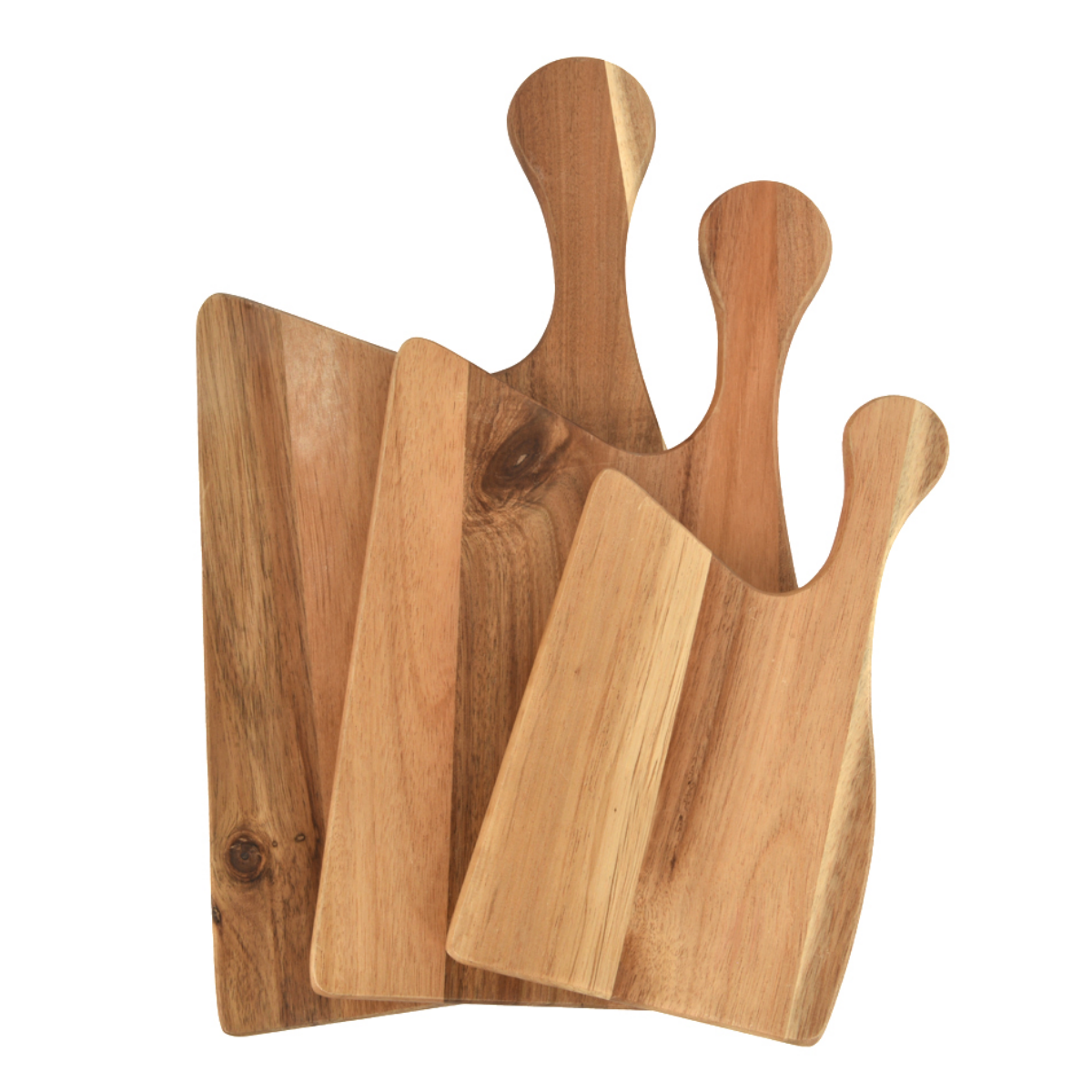
If you walked a Carrefour or Lidl kitchenware aisle in 2024 and again in 2026, the acacia and bamboo SKUs would look almost interchangeable. Both are pale-to-warm brown, both retail between roughly $14 and $45 on Amazon’s kitchen category, both carry the same “FDA food contact” mark on the hangtag. And yet, the year-end return data tells a different story: bamboo boards dominate the under-$20 tier on listing velocity but lose share above $30, while acacia boards hold the $30 to $45 tier with much lower return rates on cracking and warping complaints. As an acacia wood cutting board buyer building a private-label program, the question is not which material is objectively better; it is which material behaves predictably for your specific climate, your retail channel, and the price point your category manager has set.
This guide unpacks that question across three engineering dimensions that matter to wholesale buyers: equilibrium moisture content (EMC) and 24-hour swelling, Janka hardness and knife-friendliness, and food-safe coating compliance under FDA 21 CFR 175.300 and EU Regulation (EC) No 1935/2004. We close with a retail margin model at three price tiers ($15 / $25 / $40) so you can defend the material decision to your category buyer with actual numbers, not just aesthetic preference. Where you see our material referenced as a “bamboo cutting board supplier” partner later in the article, we are citing our own production lines in Ningbo, where both materials run on shared conditioning kilns but require different finishing protocols. For buyers ready to request cutting board samples in either material, our sample policy is summarized in Section 8.
How Acacia and Bamboo Compare on Hardness, Density, and Fiber Structure
The two materials look similar at a glance because both are cellulose-based and both ship with light caramel tones after finishing, but they are botanically and structurally different. Acacia (typically Acacia mangium or Acacia auriculiformis in commercial supply) is a true hardwood dicot with closed-grain, dense fiber bundles. Bamboo (typically Moso bamboo, Phyllostachys edulis) is a grass with hollow vascular bundles that run the length of the culm; once laminated into a board, those bundles produce a characteristic straight-grain pattern with visible stripes.
That structural difference shows up immediately in Janka hardness testing. Side-by-side measurements place acacia at roughly 1,700 to 1,750 lbf (consistent with the industry-standard Janka hardness reference data) and Moso bamboo at roughly 1,300 to 1,400 lbf (consistent with the professional kitchen cutlery reference data), depending on lamination direction and pressing density. Translated for a retailer, acacia is meaningfully harder at the surface, which has direct consequences for both scratch resistance and knife-edge wear; we cover both consequences in Section 4. Specific gravity follows the same ranking: air-dry acacia lands around 0.65 to 0.75 g/cm³, while laminated bamboo boards typically test at 0.65 to 0.80 g/cm³, but the variation inside bamboo is wider because pressing pressure and resin content both shift the number considerably.
For buyers evaluating a bamboo cutting board supplier partner, the practical takeaway is that hardness within bamboo is not a fixed number; it is a function of how the factory presses and laminates. Two bamboo boards from two different factories can differ by 100 lbf or more on the same Janka test, even when both are labeled “Moso bamboo, food safe.” Asking for a factory-side hardness certificate (ASTM D1037 or JIS Z 2101) is one of the more reliable ways to filter out a marginal supplier.
Moisture Absorption: EMC, Swelling, and the 24-Hour Test Buyers Run
Moisture behavior is where the two materials diverge most sharply in real kitchens, and it is also where most retail warranty claims originate. Wood and bamboo are both hygroscopic; they gain and lose moisture until they reach equilibrium moisture content (EMC) with the surrounding air. At typical indoor conditions of 20°C and 50% relative humidity, acacia stabilizes around 8 to 10% EMC, while bamboo stabilizes around 8 to 12% EMC, depending on how aggressively the factory kiln-dried the laminations before pressing. The numbers look similar on paper, but the dynamic response is different.
In a 24-hour soak test that any QA lab can run, acacia swells roughly 4 to 6% in width and 2 to 3% in thickness, while bamboo swells roughly 6 to 9% in width and 3 to 5% in thickness. Translated to a 30 × 40 cm acacia board, that is a 12 to 18 mm width change after one wet cycle. Translated to the same board in bamboo, it is 18 to 27 mm. After three wet-dry cycles, bamboo boards typically begin to show edge cracking at the lamination lines, while acacia boards show surface checking at the heartwood boundary but rarely delaminate. The moisture behavior is documented in the European Parliament’s 2016 study on food contact materials as a contributing factor to in-service product failure for wood-based articles. This is the engineering reason that bamboo boards tend to come with a “do not soak” or “do not dishwasher” warning on the hangtag, and it is also the engineering reason that acacia boards dominate the $30-plus retail tier where buyers expect a longer service life.
For wholesale buyers, the moisture story has two practical consequences. First, conditioning time before finishing matters: acacia needs 7 to 14 days of kiln conditioning, bamboo needs 14 to 21 days because the laminated layers trap internal moisture. A factory that quotes identical lead times for both materials is almost certainly shorting the bamboo cycle. Second, retail packaging should specify a use environment. If your retail channel is Northern Europe with winter indoor RH around 25%, EMC drops, and both materials will contract slightly; if it is Southeast Asia with summer RH around 75%, both materials will swell and bamboo is the more vulnerable of the two.
Knife-Friendliness: Janka Rating and What It Means for Retailer Returns
Knife-friendliness is where the Janka numbers in Section 2 turn into a customer-service conversation. In independent kitchen-gear reviews and professional kitchen benchmark testing, acacia boards are typically described as “moderate on knives,” while bamboo boards are typically described as “harder on knives than most hardwoods.” The difference comes from silica content: bamboo deposits silica in its vascular bundles as the culm matures, and that silica survives lamination and pressing. Acacia has lower silica content than maple or beech, but more than walnut. In practical terms, both materials will dull a chef’s knife faster than end-grain maple or hinoki cypress, but bamboo will do it faster than acacia.
For a private-label program, the choice between acacia and bamboo on knife-friendliness depends on your retail price tier and your customer profile. At the $15 entry tier, customers are price-sensitive and replace the board every 12 to 18 months; knife dulling is not a return driver. At the $25 mid-tier, knife dulling starts to show up in negative reviews, especially on Amazon, where “dulled my good knives” is a recurring complaint on bamboo SKUs. At the $40-plus premium tier, knife-friendliness is a real purchase driver, and acacia holds a measurable edge in side-by-side testing.
There is one nuance worth flagging. End-grain construction on either material reduces the dulling effect substantially, because the knife edge passes between fibers rather than across them. End-grain acacia is a premium-tier product; end-grain bamboo is rarer and harder to manufacture reliably, because bamboo’s vascular structure does not lend itself to true end-grain orientation. If your program targets professional or prosumer buyers, end-grain acacia is worth a serious look; if it targets entry-level home cooks, side-grain bamboo is still the right cost-versus-performance answer.
Food-Safety: Coatings, Migratable Substances, and What Spec Sheets Must Show
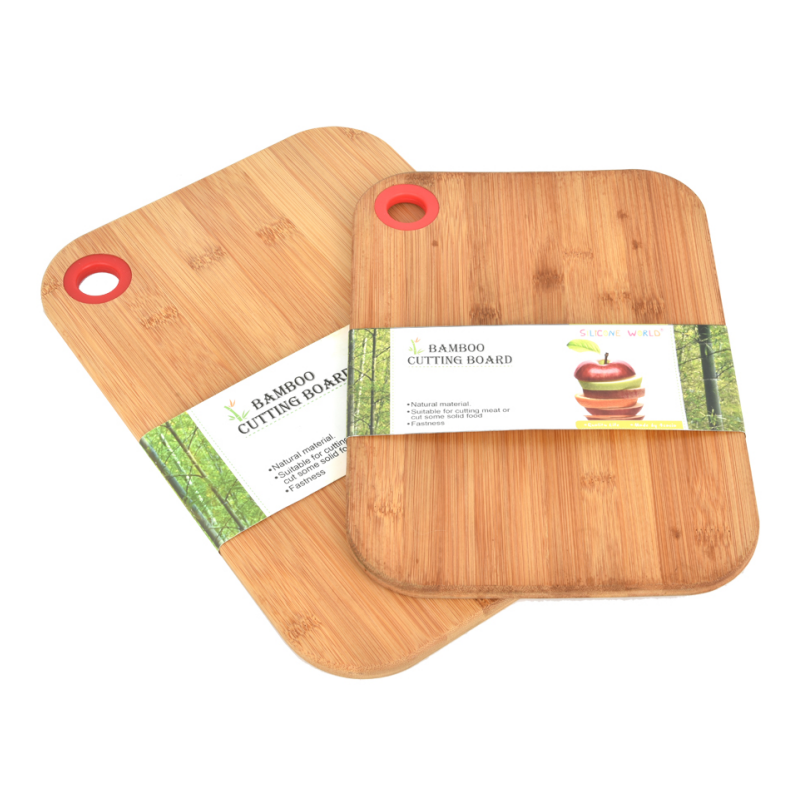
Both materials are FDA-approved for direct food contact when supplied in their natural, unfinished form. Acacia heartwood is non-toxic and low-allergen; Moso bamboo is similarly food-safe once any residual starch is washed out of the laminations. The compliance question is therefore not about the substrate; it is about the coating. Most retail boards carry a food-grade mineral oil finish, often blended with beeswax for water resistance. Mineral oil itself is regulated under FDA 21 CFR 172.878 as a direct food additive, and the cured oil film on a board is generally recognized as safe.
What changes the regulatory picture is whether the factory uses any resin, lacquer, or polymer coating beyond mineral oil. If the board carries a polyurethane or epoxy-based topcoat for “waterproof” or “dishwasher-safe” claims, that coating falls under FDA 21 CFR 175.300 (resinous and polymeric coatings) for the US market and under EU Regulation (EC) No 1935/2004 plus the specific measure Regulation (EU) No 10/2011 for the European market. The 175.300 limit is 0.5 mg per square inch of total non-volatile chloroform-soluble extractives under conditions of intended use. The 1935/2004 framework requires a Declaration of Conformity covering overall migration limits, specific migration limits, and organoleptic properties.
For buyers running a private-label program in both markets, the practical spec-sheet requirement is straightforward. First, request the coating type (mineral oil only, mineral oil plus beeswax, or polymer topcoat) on every purchase order. Second, for any polymer-coated SKU, request the Declaration of Conformity referencing both 175.300 and 1935/2004 with the test report attached. Third, specify the maximum use temperature on the hangtag; hot cookware above 70°C can accelerate migration in polymer-coated boards and would push the SKU into a different regulatory sub-class. Yawen’s standard offering for both materials is food-grade mineral oil plus beeswax, which keeps the SKU in the lowest-friction compliance category for both US and EU retail.
For European buyers, the German Federal Institute for Risk Assessment (BfR food contact materials reference) maintains the most comprehensive positive list of substances suitable for food contact articles including wood and bamboo kitchenware, and is the authoritative reference for any factory-side compliance documentation in the German market.
Manufacturing Lead Times and the Hidden Cost of Long Conditioning
Lead time is one of those line items that looks identical on a quote sheet but diverges sharply once the conditioning math is done. Bamboo lamination requires pressing at 130 to 160°C under 1.0 to 1.5 MPa for 20 to 40 minutes per board, followed by a 14 to 21-day post-press conditioning window to drive residual moisture below 10% EMC. Acacia requires 60 to 90 minutes of hot-press per board and a 7 to 14-day conditioning window. The press cycle is shorter for bamboo because the laminated layers cure faster; the conditioning window is longer because the layered structure traps more internal moisture.
Translated into a typical 5,000-unit production run, acacia boards finish in roughly 18 to 22 working days from raw-material release, and bamboo boards finish in 24 to 30 working days. For a private-label program planning a fall retail launch with an August cutoff for samples and a September cutoff for production, that 6 to 8-day difference is real calendar time. The factory that promises “30 days for both” is almost always cutting the bamboo conditioning cycle short, which then shows up as in-store warping claims four to six weeks after the SKU lands on the shelf.
There is also a working-capital angle worth flagging. Bamboo laminations have a higher reject rate during pressing (typically 3 to 5% versus 1 to 2% for acacia) because voids between the bamboo strips telegraph as visible defects on the finished surface. The factory absorbs that cost or bills it back through a higher per-unit price; either way, the buyer is paying for it. For a 5,000-unit run, the reject differential is in the order of 100 to 150 units, which at $5 per unit landed cost is roughly $500 to $750 of working capital sitting in the reject pile.
Retail Margin: Acacia vs Bamboo at Three Price Tiers
The retail margin model below uses a representative European private-label program with landed FOB Ningbo cost, 18% duty, 12% inland freight, 28% retail markup, and 6% retail returns provision. We use a 5,000-unit production run, which is the typical MOQ for first-time private-label programs across both materials.
| Tier | Material | FOB Cost / unit | Landed Cost / unit | Retail Price | Gross Margin / unit | Margin % |
|---|---|---|---|---|---|---|
| Entry ($15) | Bamboo | $3.40 | $4.65 | $14.99 | $10.34 | 69.0% |
| Entry ($15) | Acacia | $3.85 | $5.26 | $14.99 | $9.73 | 64.9% |
| Mid ($25) | Bamboo | $5.20 | $7.11 | $24.99 | $17.88 | 71.5% |
| Mid ($25) | Acacia | $5.85 | $7.99 | $24.99 | $17.00 | 68.0% |
| Premium ($40) | Bamboo | $7.40 | $10.11 | $39.99 | $29.88 | 74.7% |
| Premium ($40) | Acacia | $8.10 | $11.07 | $39.99 | $28.92 | 72.3% |
| Premium ($40) | Acacia, end-grain | $11.20 | $15.31 | $39.99 | $24.68 | 61.7% |
Two patterns emerge from the table. First, gross margin percentage actually favors bamboo at every tier, by roughly 2 to 4 percentage points, because the per-unit FOB cost is lower. Second, the absolute margin per unit is within $2 across materials at each tier, so the per-unit revenue gap is small. Third, the returns and warranty provision hits bamboo harder in practice: a 6% returns rate on bamboo absorbs roughly $0.30 per shipped unit, versus $0.18 per shipped unit on acacia at the entry tier, because bamboo returns cluster around warping and lamination failures rather than cosmetic issues.
Net of returns and warranty, the retail margin ranking flips at the premium tier: acacia ends the year with a higher net margin per unit because the lower returns rate compensates for the higher FOB cost. At the entry tier, bamboo remains the more profitable choice despite the returns drag, because the retail velocity is roughly 1.8x higher in that tier. The mid-tier is genuinely material-neutral and should be decided on brand positioning rather than margin math.
Sourcing Decision Matrix for Kitchenware Buyers
The decision matrix below maps six typical buyer profiles to the recommended material. It is intentionally binary at the entry tier (where bamboo wins on cost and velocity) and intentionally non-binary at the premium tier (where acacia, end-grain acacia, and bamboo each have a defensible position depending on the buyer profile).
| Buyer Profile | Recommended Material | Price Tier | Key Reason |
|---|---|---|---|
| Entry-tier discount retailer (Lidl, Aldi) | Bamboo | $15 | Lowest FOB, highest velocity, acceptable returns rate |
| Mid-tier supermarket (Carrefour, Auchan) | Bamboo or Acacia | $25 | Material-neutral on margin; pick on brand story |
| Premium houseware (CASINO, DAISI) | Acacia, side-grain | $40 | Lower warranty exposure, longer shelf life |
| Chef-focused specialty retailer | Acacia, end-grain | $40+ | Knife-friendliness premium; chef gifting angle |
| Eco-positioned brand (KIK) | Bamboo, FSC-claimed | $25-40 | Sustainability narrative; “fastest-growing grass” framing |
| Private-label mass market | Bamboo + Acacia dual-line | $15 / $25 | Covers both tiers without SKU conflict |
For buyers considering a dual-line program, the practical move is to launch bamboo at the entry tier as the volume driver and acacia at the mid-to-premium tier as the margin anchor. The two materials share enough visual DNA that they read as a coherent set on a retail shelf, but they segment cleanly enough that the entry-tier SKU does not cannibalize the premium SKU. Our Yawen production lines run both materials on shared kilns, so a dual-line program does not require a second factory qualification.
Specification Checklist for RFQ Submission
Before you send a Request for Quote to a bamboo cutting board supplier or an acacia specialist, the checklist below covers the specifications a competitive private-label RFQ should lock down. Skipping any of these items leaves room for the factory to substitute lower-grade material or finish, which then shows up at the retail shelf three months later.
- Material specification: Acacia species (mangium, auriculiformis, or hybrid) or Moso bamboo origin (Fujian, Zhejiang, or Anhui); hardness certificate to ASTM D1037 or JIS Z 2101; maximum 5% moisture content at press.
- Dimensions and tolerance: Length × width × thickness with ±1 mm tolerance; edge squareness within ±0.5 mm; corner radius if specified.
- Finish specification: Food-grade mineral oil only, mineral oil plus beeswax, or polymer topcoat; brand and grade of finish; number of coats; cure time between coats.
- Compliance documentation: FDA compliance letter; LFGB Section 30/31 LFGB if selling in Germany; Declaration of Conformity for EU 1935/2004 if any polymer coating is used; California Prop 65 if selling in California.
- Branding and packaging: Laser engraving versus heat branding versus hangtag; retail box dimensions and graphic files; master carton configuration and pallet spec.
- Sample policy: Pre-production sample lead time (typically 7 to 10 days); shipping method for samples; cost recovery on first production order.
When you are ready to request cutting board samples, our standard sample kit ships two acacia SKUs (one side-grain, one end-grain) and two bamboo SKUs (one flat-laminated, one vertical-laminated) within 7 working days from Ningbo. The kit covers the four most common private-label constructions and gives your category buyer a side-by-side comparison at the retail shelf scale, not the lab scale.
Frequently Asked Questions
Is acacia wood safe for food contact?
Yes. Acacia heartwood is FDA-approved for direct food contact, non-toxic, and low-allergen. It is widely used in cutting boards, salad bowls, and serving trays across Europe, the US, and Japan.
Why is bamboo harder on knives than acacia?
Bamboo deposits silica in its vascular bundles as the culm matures. That silica survives the lamination process and ends up in the finished board, which makes the cutting surface measurably harder and more abrasive on knife edges than most hardwoods, including acacia.
Can bamboo cutting boards go in the dishwasher?
No. The high heat and prolonged water exposure of a dishwasher cycle pushes bamboo past its safe moisture range and typically causes lamination cracking within 5 to 10 cycles. Hand-wash with mild soap, towel-dry, and stand upright to air-dry.
What is the right conditioning time for bamboo before finishing?
14 to 21 days of post-press conditioning at 18 to 22°C and 50 to 60% relative humidity is the standard. Skipping this window is the most common cause of in-store warping claims 4 to 6 weeks after retail delivery.
Which material has lower retail return rates?
Acacia consistently shows lower return rates on warping and cracking complaints, typically 2 to 4% versus 5 to 8% for bamboo, because acacia’s closed-grain structure handles wet-dry cycling more reliably than bamboo’s laminated structure.
Do both materials meet EU 1935/2004 food-contact rules?
Yes, both materials meet Regulation (EC) No 1935/2004 in their natural unfinished state. If a polymer coating is added for waterproof claims, the coating itself must meet Regulation (EU) No 10/2011 specific migration limits and a Declaration of Conformity must be supplied with each shipment.
Post time: Aug-06-2026