


A cheese board in a premium gift program is not a cutting tool — it is a branded object that has to survive scrutiny twice: once on the retail shelf, where it competes on look and feel, and once at the table, where juice runs, crackers crumble, and a poorly placed groove betrays the design. At Yawen, where we have supplied bamboo cutting boards and kitchenware to European, US, Japanese, and Australian brands for more than 27 years, we run cheese board programs through our OEM/ODM design service with our Paris design office, and the same three questions decide every project: how deep the juice groove should be, how the cracker well should be sized, and where the laser engraving should sit. This guide answers all three, and adds the compliance layer that gift brands usually meet for the first time on a board like this.
TL;DR
- Juice groove depth in the 3–5 mm range with 6–8 mm width retains whey through a full service without weakening the board face.
- Size the cracker well to the cracker formats in the target market — around 100 × 100 mm fits most standard sleeves, with the well floor 3–5 mm below the serving face.
- Place laser engraving in the border zone — handle, rim band, or dedicated panel — and approve a pre-production sample for contrast against the bamboo grain.
- For US-bound programs, glue and finish fall under 21 CFR Part 177 as indirect food additives; EU programs follow EU food contact material rules with a declaration of compliance.
- Shape, wells, knife configuration, and packaging are all customizable — run them through a sample-supported OEM workflow, not artwork alone.
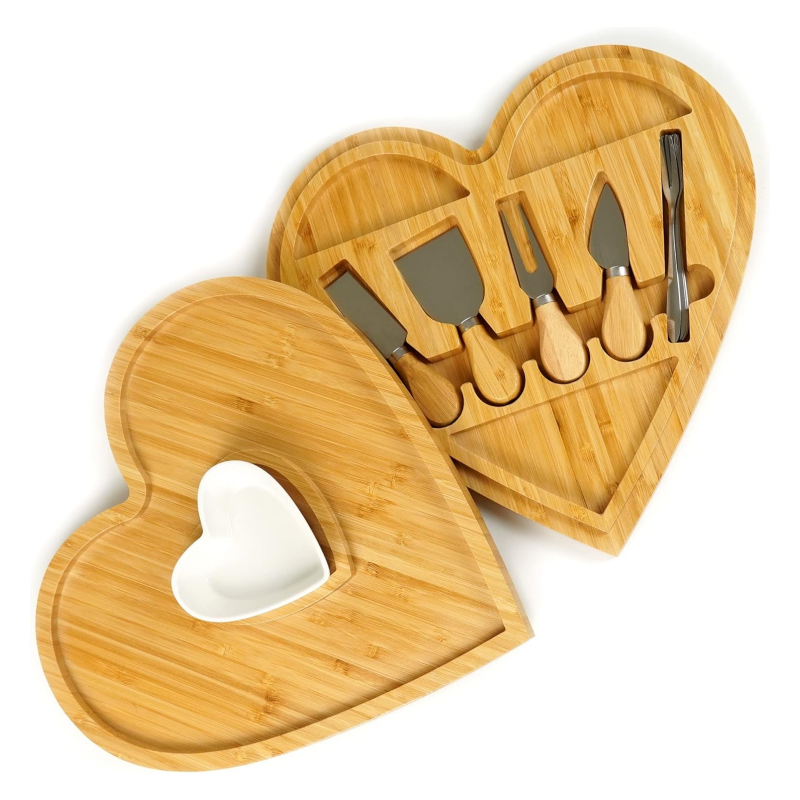
Why does juice groove depth matter more than the shape of the board?
Shape sells the first look; the groove decides whether the board is used a second time. A charcuterie service generates liquid — whey from soft cheeses, juice from grapes and figs, oil from marinated olives — and that liquid obeys gravity toward the lowest point of the serving face. A board without a groove pools liquid at the rim and ships it straight onto the table linen; a groove that is too shallow overflows within minutes of service; a groove that is too deep eats into the board’s stiffness and leaves a thin, fragile wall under the rim. In our design reviews, we settle groove depth in the 3 to 5 mm band with 6 to 8 mm width for standard-size premium boards, and we validate the choice with a wet-run test on the pre-production sample: sauce poured at the center of the face must stay inside the groove for the length of a realistic service.
Material behavior drives that geometry more than style does. Bamboo is a laminated grass — harder than most woods on the face, but it moves with humidity across the seasons, and a groove removes the very section that keeps a wide board flat. We specify groove profiles with the same fiber-direction discipline we apply across our chopping board line, where three laminated parts carry different fiber directions to keep the board stable through washing cycles; a groove cut against that logic invites cracking at the corners within the first winter. We also finish the groove floor with the same food-safe oil system as the face, because an unfinished groove floor absorbs whey, darkens, and becomes the first hygiene question a gift recipient asks. In our program reviews, I push brands to approve the groove profile and the oil system together, on one sample, because the two decisions interact in daily use in ways no rendering can show.
Care instructions close the loop, and we print them into the gift box rather than the board itself. A board that goes into a dishwasher warps within weeks, and the warping reads as a manufacturing defect even when the material was perfect. We supply each program with a care card — hand wash, dry standing, refresh the oil monthly — because a premium gift that fails early becomes a brand review instead of a brand ambassador. Our retail partners tell us the care card is the single cheapest warranty program in the category, and we have made it standard on every board we ship, private label or our own design.
Answer nugget
Groove depth is a load decision, not a style decision Because it trades liquid capacity against board stiffness: the groove removes material from the serving face, and premium boards need enough remaining section to stay flat through repeated washing and seasonal humidity swings.
How should you size the cracker well on a charcuterie platter?
The cracker well is the most mis-sized feature we see in gift programs, because designers size it from a sketch instead of from the crackers. The rule we apply is to match the well to the formats the end customer actually buys in the destination market: a well around 100 by 100 mm accommodates most standard cracker sleeves without crushing them, and we set the well floor 3 to 5 mm below the serving face so crackers stay dry above any meat juices that migrate. Round wells suit breadstick assortments; square wells stack better with rectangular sleeves; segmented wells that share volume with the groove let the whole board drain from one channel, at the cost of a slightly more complex mold. We walk brands through those trade-offs with physical samples from our showroom — over 2,000 m³ of live product — because a cracker format is a decision only hands can make.
Transit is the second half of well design, and it is where gift programs quietly fail. A board that ships with the knife set nested in a felt-lined well travels beautifully; the same board shipped with loose knives in a thin retail box arrives with edge dents pressed into the groove walls. We design the well, the knife slots, and the gift box as one assembly, and we run a drop-and-vibration review on the packed unit before volume approval — not on the bare board. We also reserve a flat zone beside the well for the charcuterie itself, because a board that dedicates too much area to wells leaves the host arranging prosciutto on the rim. Our rule of thumb from years of gift programs: the serving face should keep at least two-thirds of its area flat and usable, whatever the well configuration promises on the shelf.
Answer nugget
Well size follows the cracker, not the drawing Because a well that is too tight crushes product and one that is too loose lets crackers rattle and snap in transit — the right dimension comes from the target SKU, then the groove and rim design work around it.
Where should laser engraving sit on a gift cheese board?
Engraving is where the brand lives, so it must survive both regulation and use. We position artwork in the border zone — the handle area, a rim band, or a dedicated panel outside the main food-contact face — for two reasons. First, brand marks inside the primary serving face see knife contact, oil absorption, and fading contrast within months, while border-zone engraving stays legible for the life of the board. Second, food-contact compliance is cleaner when branding sits where food does not: for US-bound programs, any coating or finish is treated as an indirect food additive under 21 CFR Part 177, and engraving does not change that status, but keeping the marked zone out of the cutting face simplifies the declaration. Bamboo grain varies batch to batch, so we always run a pre-production engraving sample and check contrast under retail lighting before the brand approves volume — a logo that disappears into a light grain band is a gift-program failure discovered too late.
Answer nugget
Engraving belongs in the border zone Because that placement protects both the brand mark and the compliance story: knife contact fades artwork on the serving face, and keeping marked areas out of the food zone keeps the food-contact declaration simpler for every market the gift program enters.
Depth and darkness of the burn also carry brand meaning. A shallow mark reads premium on light bamboo but washes out in photography; a deeper burn photographs beautifully but can read as rustic rather than luxury. We engrave two sample depths for every new gift brand and let their marketing team choose under the same lighting their product photos use. For anniversary and corporate gifting runs, we align the engraving position with the gift box window so the logo is visible without unboxing — a small detail that turns a kitchen item into a display object on the shelf.
What compliance checks do gift programs miss?
Buyers who source cutting boards daily sometimes forget that a gift cheese board crosses regulatory lines a plain board does not. The board itself — solid bamboo, food-safe glue, no plastic filler — is the easy part; the questions come from the extras. Knife sets, ceramic ramekins, and slate inserts each carry their own food-contact and packaging obligations. For US programs, we align glue and finish selections with 21 CFR Part 177 and confirm the substance status against the FDA’s inventory of effective food contact substance notifications; for EU programs, we work to the EU food contact materials framework, where a written declaration of compliance from the supplier is the document retailers ask for at intake. We build these review points into the sampling stage rather than the shipping stage, because a compliance document discovered at the warehouse is a delay, while the same document requested at sampling is a checkbox. We learned this the practical way: a gift program for a European retail chain stalled in intake when the declaration of compliance arrived one week after the goods, and the lesson we took from that order now shapes every program we run — compliance paperwork travels with the sample, not behind the shipment. When a buyer asks us what documents a bamboo cheese board program needs, we answer with the destination market first: US programs center on the 21 CFR Part 177 status of every adhesive and finish, EU programs center on the framework regulation and its declaration of compliance, and both benefit from substance-level traceability that starts at material selection, not at the lab.
How does the design move from artwork to a volume gift program?
Our OEM/ODM workflow for premium kitchenware runs in five stages, and each stage protects a different part of the design intent — send your artwork through cheese board customization inquiry and we return a sample-backed plan:
- Design brief: board shape, groove layout, well format, knife configuration, and packaging structure are fixed in one document.
- Sampling: a physical sample with real engraving and real packaging lets the brand test the table performance, not just the look.
- Wet-run and wear review: groove capacity, cracker fit, and engraving contrast are checked against the destination market’s actual products.
- Compliance pack: food-contact documentation for the destination market is assembled alongside the production order.
- Volume production and packaging: gift boxing and brand artwork are verified against the approved sample before the first carton seals.
Brands we serve through this workflow — retailers and importers across Europe, the US, Japan, South Korea, Australia, and Brazil, including mass-market and premium names we list on our premium kitchenware OEM page — use it because the showroom-and-sample loop, backed by our own Paris design company established in 2007, catches design errors while they are still free to fix. We keep more than 80 professionals across the program, and the same team that designs the board answers the tolerances.
Two program types dominate our gift-brand order book, and each pulls the design in a different direction. Seasonal corporate gifting — year-end and holiday programs — prioritizes logo visibility, packaging impact, and a reliable repeat order cycle, so we steer those brands toward proven shapes with customized engraving and box art, which keeps lead times short and sampling costs near zero. Retail private-label programs — the cheese board sets that sit in kitchenware aisles — compete on the product itself, so we push those brands to invest in a distinctive well layout, a standable or handle-led silhouette, and a knife configuration that photographs as a set. We have watched both paths succeed, and we have watched brands fail by spending the retail budget on seasonal packaging and the seasonal budget on custom molds. Matching the design investment to the program type is the first review we run on any new inquiry.
Mold development deserves its own line of caution. Custom wells, grooves, and shapes require new tooling, and we develop molds in-house with sample support so the brand sees and tests the real part before committing to volume. But a mold is a marriage, not a purchase: the brand should expect to iterate the sample two or three times, and we schedule that iteration into the program timeline rather than treating it as an exception. Brands that budget time for sample rounds ship on schedule; brands that compress them discover the groove problem in the warehouse, where it costs the most.
Sustainability messaging is the last design layer we discuss, and it is simpler than most brands expect. Solid bamboo renews fast, carries no plastic content when we omit the filler grades, and can be composted at end of life — but a claim is only as good as its paperwork, so we prepare the material story with the same discipline as the compliance story. We advise brands to claim what the documentation supports and nothing more, because an overreached green claim in a gift program invites exactly the audit a premium brand cannot afford.
FAQ
What juice groove depth works for a bamboo cheese board?
A groove depth in the 3 to 5 mm range with 6 to 8 mm width is the common working specification for premium boards: deep enough to retain whey and fruit juice during a full service, shallow enough to keep board stiffness and leave a full usable cutting face.
How big should the cracker well be on a charcuterie platter?
Match the well to the cracker formats the end customer actually buys — a well around 100 by 100 mm holds most standard cracker sleeves without crushing, and the well floor should sit 3 to 5 mm below the serving face so crackers stay clear of meat juices.
Where should laser engraving be positioned on a gift cheese board?
Position engraving in the border zone outside the main food contact face — the handle area, rim band, or dedicated panel — and run a pre-production sample to confirm contrast against the bamboo grain before approving volume.
What food-contact compliance does a bamboo cheese board need?
For the US market, the board’s glue and any finish are treated as indirect food additives under 21 CFR Part 177, and EU-bound programs follow EU food contact material rules with a written declaration of compliance from the supplier.
Can the design be customized for a private-label gift program?
Yes — board shape, groove layout, wells, knife configuration, engraving artwork, and packaging are all customizable items. A sample-supported OEM/ODM workflow with mold development and pre-production approval keeps the design intent intact into volume.
Post time: Nov-05-2026