


Why FSC Verification Matters for European Kitchenware Importers
FSC (Forest Stewardship Council) certification is the baseline sustainability requirement for bamboo kitchenware products sold through most European retail chains, and the verification process is the importer’s first line of defense against greenwashing claims, retailer delisting, and reputational damage. The verification process matters because the FSC label is one of the most recognized sustainability labels in the European consumer market, and a product carrying an FSC label that is not properly backed by valid documentation can trigger retailer audits, consumer complaints, and regulatory action.
For European kitchenware importers, the verification process typically happens at three stages: the supplier qualification stage before the first purchase order, the per-shipment stage at the time of each commercial invoice, and the annual audit stage when the importer’s sustainability team reviews the supply chain. Each stage requires a different set of documents, and the importer should have a clear documentation checklist for each stage. The absence of a structured verification process is the most common cause of compliance issues, and it is also the most common cause of importers discovering after the fact that their supplier’s FSC certification is not what it was represented to be.
From our work with European kitchenware importers, the most common compliance issues fall into four categories. The first is the use of an expired FSC certificate that has not been renewed by the supplier. The second is the use of a valid FSC certificate with a scope that does not cover the specific product category being sourced. The third is the mislabeling of an FSC Mix product as an FSC 100% product. The fourth is the absence of a transaction certificate for a specific shipment, which means the FSC claim cannot be traced back to a specific batch of bamboo. Our FSC certification documentation addresses all four categories through the per-shipment transaction certificate process.
The Four Essential Documents to Request From Every Bamboo Supplier
The FSC certification framework is built on four essential documents, and every European kitchenware importer should request all four from every bamboo supplier before placing the first purchase order. The documents are layered, with each one building on the previous, and the absence of any one of the four documents is a red flag that warrants further investigation before the import relationship begins.
The first document is the FSC forest management certificate. This certificate is issued to the entity that owns or manages the bamboo forest, and it confirms that the forest is being managed according to FSC’s environmental, social, and economic standards. The certificate is valid for five years and is renewed through an independent audit. For bamboo kitchenware, the forest management certificate covers the bamboo plantation that supplies the raw material, and it is the foundation of the FSC claim. Importers should verify the certificate holder name matches the entity that supplies the bamboo, and the certificate scope covers the geographic region where the bamboo is grown.
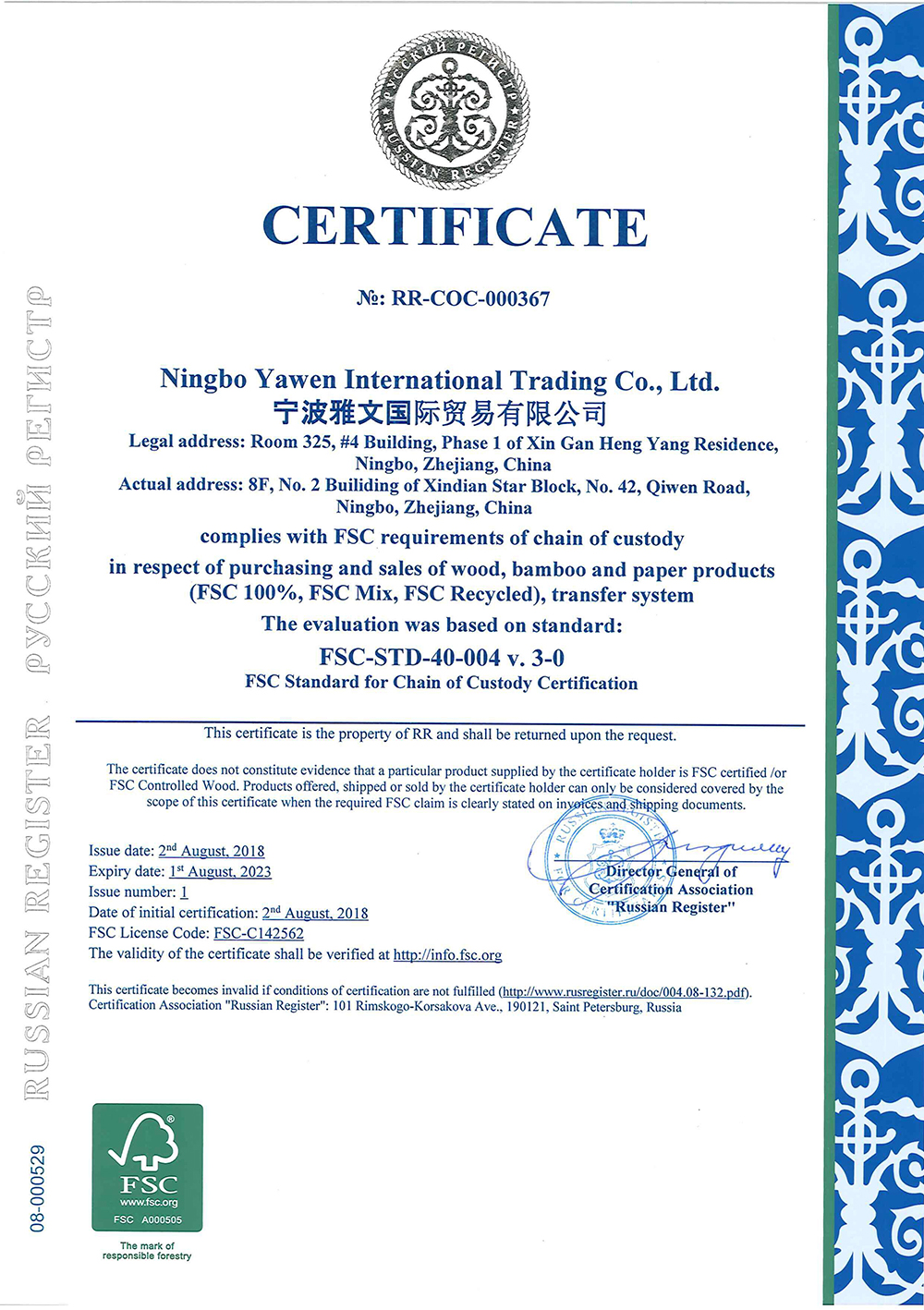
The second document is the FSC chain of custody certificate. This certificate is issued to the manufacturing facility that processes the bamboo into finished products, and it confirms that the facility has the systems in place to track FSC certified material through the production process. The chain of custody certificate is valid for five years and is renewed through an independent audit. For bamboo kitchenware, the chain of custody certificate covers the factory that produces the cutting boards, cheese boards, and kitchen organizers, and it is the proof that the FSC claim survives the manufacturing process. Importers should verify the certificate holder name matches the entity on the commercial invoice, and the certificate scope covers the specific product category being sourced.
The third document is the FSC product claim statement. This document is issued by the manufacturer for each specific product SKU, and it specifies the FSC claim (100%, Mix, or Recycled) for that SKU. The product claim statement is generated based on the bamboo input mix used in the product, and it is the document that determines what label can be used on the retail packaging. For bamboo kitchenware, the product claim statement is typically issued annually or when the product SKU changes, and it should match the label claim on the finished product. Importers should verify the product claim statement is current and covers the specific SKU being ordered.
The fourth document is the FSC transaction certificate. This document is issued for each individual shipment and confirms the FSC claim for the specific goods being imported. The transaction certificate includes the invoice number, the volume of FSC certified product, the FSC claim, and the certificate numbers of the supplier’s forest management and chain of custody certificates. The transaction certificate is the document that customs authorities and retailer compliance teams use to verify the FSC claim, and it is the per-shipment evidence that the goods in the container are covered by the FSC certification. Importers should request the transaction certificate for every shipment and retain it for at least five years for audit purposes.
FSC 100% vs FSC Mix vs FSC Recycled: Which Certificate Type to Source
The three FSC certificate types correspond to three different bamboo input mixes, and the choice between them affects the retail labeling, the consumer messaging, and the procurement pricing. For European kitchenware importers, the choice between FSC 100% and FSC Mix is the most common decision, because FSC Recycled is not applicable to bamboo kitchenware products that require virgin bamboo fiber for the cutting surface.
FSC 100% means that all the fiber in the product comes from FSC certified forests that have been independently audited against FSC’s forest management standards. The fiber input is 100 percent traceable to a certified bamboo forest, and the product carries the FSC 100% label. For bamboo cutting boards and cheese boards, FSC 100% is the premium certificate type and the one that supports the strongest sustainability messaging in retail. The procurement pricing for FSC 100% is typically 5 to 10 percent higher than FSC Mix because the bamboo supply chain is more tightly controlled.
FSC Mix means the product contains a mixture of FSC certified fiber, controlled fiber, and recycled fiber, with the FSC certified portion making up at least 70 percent of the total. The product carries the FSC Mix label, and the consumer messaging focuses on the responsible sourcing of the certified portion. For bamboo kitchenware, FSC Mix is the most common certificate type in the market because the bamboo supply chain in China typically involves a mix of certified and non-certified bamboo plantations, and the FSC Mix framework allows the manufacturer to use both inputs while maintaining the FSC label on the finished product.
FSC Recycled means the product is made entirely from post-consumer or pre-consumer reclaimed materials. For bamboo kitchenware, FSC Recycled is not applicable to most products because the cutting surface requires virgin bamboo fiber for food safety and durability. The exception is bamboo fiber composite products where the bamboo fiber is reclaimed from manufacturing waste, which can qualify for FSC Recycled. For European importers sourcing standard bamboo cutting boards and cheese boards, FSC 100% and FSC Mix are the two certificate types to evaluate.
Verification Steps: How to Check an FSC Certificate Is Valid
The verification process for an FSC certificate is straightforward, and it should be a standard step in the supplier qualification process for every European kitchenware importer. The verification uses the FSC public certificate database, which is available at info.fsc.org and provides real-time certificate status for every FSC certificate issued worldwide. The verification process has four steps, and each step should be documented in the importer’s compliance file for the supplier. The FSC public database is hosted at the FSC International website, and the database search is free to use for any importer who wants to verify a supplier’s certificate status.
The first step is to verify the certificate is current. The FSC public database shows the certificate issue date and expiry date, and the importer should confirm the certificate has not expired. FSC certificates are typically valid for five years, and a supplier with an expired certificate is operating outside the FSC framework. The importer should not accept any FSC claim from a supplier with an expired certificate, and the goods should not carry the FSC label.
The second step is to verify the certificate scope. The FSC public database shows the scope of certification, which specifies the product categories and the geographic regions covered by the certificate. The importer should confirm the scope covers the specific product category being sourced (for example, bamboo kitchenware, bamboo cutting boards, or bamboo fiber products) and the specific country of manufacture. A certificate with a scope that does not cover the product being sourced is not valid for that product, even if the certificate itself is current.
The third step is to verify the certificate holder name. The FSC public database shows the certificate holder name, and the importer should confirm the name matches the entity on the commercial invoice. A common greenwashing practice is to use a valid FSC certificate from a different entity, and the name mismatch is the first signal that the certificate is being used inappropriately. The importer should also verify the certificate holder is the same entity that the importer is contracting with, not a related or unrelated third party.
The fourth step is to verify the chain of custody. The FSC chain of custody certificate is separate from the forest management certificate, and both must be current and valid. The importer should verify the chain of custody certificate is held by the manufacturing facility that produces the goods, and the certificate scope covers the specific product category. The chain of custody verification is the most commonly skipped step, and it is the one that catches the most compliance issues.
Common Greenwashing Practices to Watch For
Greenwashing in the bamboo kitchenware category typically takes four forms, and European importers should be familiar with each pattern. The first pattern is the use of a valid but unrelated FSC certificate, where the supplier presents an FSC certificate that is current and in the right scope but held by a different entity or covering a different product category. The second pattern is the mislabeling of an FSC Mix product as an FSC 100% product, typically on the retail packaging or the product insert card. The third pattern is the use of an expired FSC certificate, where the supplier continues to use the FSC label after the certificate has expired but before the next audit cycle. The fourth pattern is the use of a fraudulent FSC certificate, where the supplier presents a certificate that was never issued by FSC or that has been altered.
For importers, the defense against all four patterns is the same: the four-document verification process at the supplier qualification stage, the per-shipment transaction certificate review, and the annual audit of the supplier’s FSC documentation. Importers who skip any of these three steps are exposed to the greenwashing risk, and the cost of a compliance issue at the retail level typically far exceeds the cost of the verification process. From our experience with European kitchenware retailers, a single greenwashing incident can trigger a supplier audit across the entire retail chain vendor list, and the cost of the audit plus the potential delisting is significant.
For bamboo kitchenware importers who are evaluating a new supplier, the verification process should happen before the first purchase order is placed. The supplier should be asked to provide the four FSC documents, and the importer should verify all four documents against the FSC public database. The verification should be documented in the supplier qualification file, and the documents should be retained for at least five years. Our FSC and GRS certification documentation is structured to make the four-document verification straightforward for European importers, with the certificate numbers and the per-shipment transaction certificate issued as standard documentation.
FSC vs PEFC: Which Certification to Require
For European kitchenware importers, the choice between FSC and PEFC (Programme for the Endorsement of Forest Certification) is a strategic question that depends on the target retail channel and the geographic market. FSC and PEFC are both global forest certification systems, but they have different governance structures, different national member organizations, and different market recognition profiles. Most European retail chains accept both certifications, but FSC is the more widely recognized certification in the European market and is the default requirement for most retail chain vendor lists.
The practical difference for European kitchenware importers is that FSC certification is required for most retail chain vendor lists, while PEFC certification may be accepted as an equivalent in some markets. For bamboo kitchenware products, FSC is the more common certification in the Chinese supply base, and the FSC certification infrastructure in China is more developed than the PEFC infrastructure. The result is that bamboo kitchenware importers sourcing from China typically work with FSC certified suppliers, and PEFC certification is more common in European hardwood products than in bamboo products.
For importers who want to maximize the retail channel access, the safest choice is to require FSC certification as the baseline. The FSC certification is accepted by virtually all European retail chains, and the documentation is standardized globally. PEFC certification can be added as an alternative for buyers who specifically require it, but it should not be used as a replacement for FSC in the European market. The combined FSC plus PEFC claim is sometimes seen on products that are certified to both systems, but the FSC claim is the primary one for the European market. The FSC International and the PEFC Council both maintain public databases of certified companies and products, and importers can cross-reference both databases to verify the dual certification status of a supplier.
Annual Audit and Supply Chain Documentation Maintenance
The annual audit process is the third stage of the FSC verification framework, and it is the stage where the importer’s sustainability team reviews the supplier’s FSC documentation across the full year of shipments. The annual audit typically happens in the first quarter of the following year, and it covers the transaction certificates for all shipments in the previous calendar year. The audit should verify the FSC claim for each shipment, the total volume of FSC certified product imported, and the consistency of the FSC labeling on the retail packaging.
For European kitchenware importers, the annual audit is also the opportunity to review the supplier’s FSC certification status for the coming year. If the supplier’s FSC certificate is approaching expiry, the importer should request the renewal documentation in advance. If the supplier’s FSC certificate has been suspended or withdrawn during the previous year, the importer should investigate the cause and assess whether the supplier remains a viable FSC certified source. The annual audit is also the opportunity to evaluate the supplier’s chain of custody documentation and to request a copy of the most recent independent audit report. For the equivalent annual audit framework in the broader forest product certification space, the Rainforest Alliance publishes annual certification reports for the agricultural and forestry sectors, and the Global Standard (GRS + GOTS) publishes the annual transaction certificate reports for the recycled content space.
For the supply chain documentation maintenance, the importer should retain the transaction certificates for all shipments for at least five years, and the supplier qualification file should be updated annually with the current FSC certificates. The documentation should be organized by supplier and by year, and the file should be available for inspection by retailer compliance teams, customs authorities, and independent auditors. The cost of the documentation maintenance is low compared to the cost of a compliance issue, and the documentation is the importer’s primary defense in the event of an audit or a regulatory inquiry.
Frequently Asked Questions from European Kitchenware Importers
What is the difference between FSC 100%, FSC Mix, and FSC Recycled?
FSC 100% means all the fiber in the product comes from FSC certified forests that have been independently audited against FSC’s forest management standards. FSC Mix means the product contains a mixture of FSC certified fiber, controlled fiber, and recycled fiber, with the FSC certified portion making up at least 70 percent of the total. FSC Recycled means the product is made entirely from post-consumer or pre-consumer reclaimed materials. For bamboo cutting boards, FSC 100% and FSC Mix are the two most common certificate types, and the choice between them depends on the bamboo supply chain structure. Bamboo forests that are directly certified by FSC return FSC 100%, while bamboo sourced from a mix of certified and non-certified forests returns FSC Mix.
What documents should European importers request from their bamboo supplier?
The four essential documents are the FSC certificate for the bamboo forest management entity, the FSC chain of custody certificate for the manufacturing facility, the FSC product claim statement for the specific product SKU, and the FSC transaction certificate for each shipment. The forest management certificate proves the bamboo comes from a sustainably managed forest. The chain of custody certificate proves the manufacturing facility has the systems in place to track FSC certified material through the production process. The product claim statement confirms the FSC claim (100% or Mix) for the specific product. The transaction certificate is the per-shipment documentation that proves the FSC claim for the specific goods being imported.
How can importers verify an FSC certificate is valid and not expired?
The FSC maintains a public certificate database at info.fsc.org where any FSC certificate can be verified by entering the certificate number. The database shows the certificate holder name, the certificate type, the scope of certification, the issue date, and the expiry date. Importers should verify the certificate is current (not expired), the certificate scope covers the specific product category being sourced, and the certificate holder name matches the supplier entity on the commercial invoice. A common greenwashing practice is to use a valid but unrelated FSC certificate, so the scope verification is as important as the expiry verification.
What is the difference between FSC and PEFC certification?
FSC and PEFC are both global forest certification systems, but they operate through different national member organizations and have different governance structures. FSC was established in 1993 and is more widely recognized in the European market. PEFC was established in 1999 and is more widely recognized in some Asian and North American markets. Both systems cover sustainable forest management and chain of custody, and both are accepted by most European retail chains. The practical difference for importers is that FSC is typically the required certification for European retail chains, while PEFC may be accepted as an equivalent in some markets. For bamboo products, FSC is the more common certification.
Can an FSC Mix bamboo product be sold with an FSC 100% label?
No. The FSC labeling rules are strict about the match between the certificate type and the label claim. An FSC Mix product must carry the FSC Mix label, not the FSC 100% label. An FSC 100% product carries the FSC 100% label. Mislabeling is a serious compliance issue and can trigger retailer delisting, regulatory action, and reputational damage. Importers should verify the label claim against the product claim statement and the transaction certificate for each shipment, and any discrepancy should be raised with the supplier before the goods are released for retail distribution.
For European kitchenware importers building a bamboo kitchenware range with FSC certification, our team can provide the four-document verification package, the per-shipment transaction certificate, and the product claim statement for the specific SKUs in your range. Reach out through our certification documentation page with your target retail channel, expected annual volume, and target port to receive the FSC documentation package within two business days.
Written by the Ningbo Yawen International Trading editorial team. We are a specialized manufacturer and exporter of bamboo kitchenware based in Ningbo, China, with FSC certified bamboo supply chains and GRS 4.0 certification for recycled content products. Our cutting board, cheese board, and kitchen organizer ranges are sold through kitchenware distributors in 17 countries across Europe, North America, and Oceania. Every product is built to retail specification with FDA food-safe finishes and EU food contact compliance. Browse our full range at yawenkitchen.com.
Post time: Jul-15-2026