


A bamboo serving spoon and salad fork set spec sheet for North American distributors lives or dies on four numbers: handle length, bowl depth, food-grade oil finish grade, and verified high-temperature dishwasher cycle performance. Most quotations I review skip three of those four. Because the North American retail market expects the set to survive real dishwasher cycles in real consumer hands, the procurement conversation has to start with the four-number spec, not the unit price.
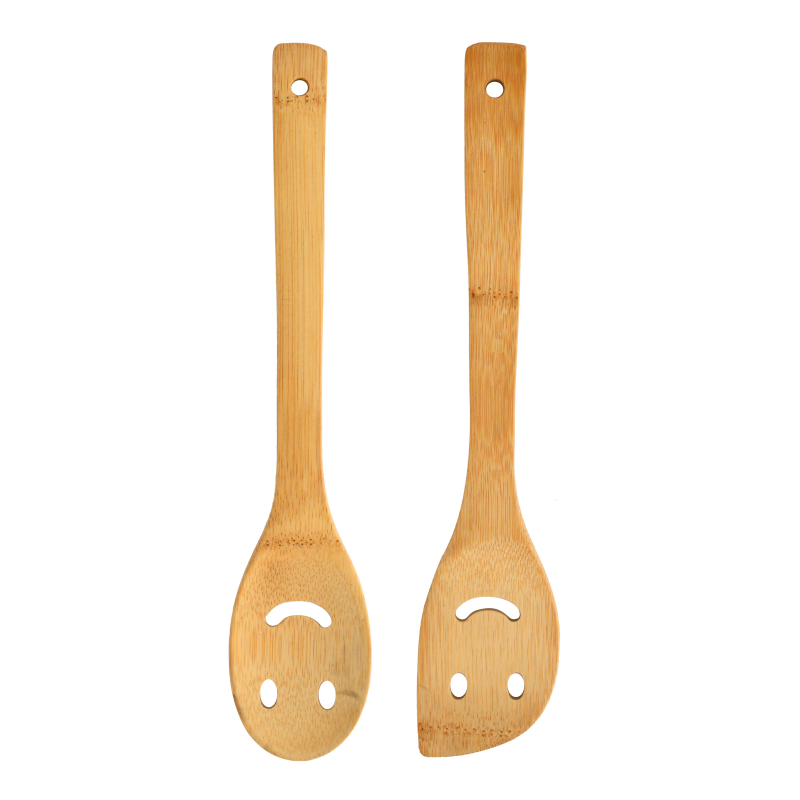
What Four Numbers Should Be on Every Bamboo Serving Spoon and Salad Fork Set Spec Sheet?
The four-number spec is short, and every serious distributor should be able to read it on a quotation in under a minute.
Serving spoon handle length (30 cm to 36 cm)
The first number is the serving spoon handle length. For a North American retail program, the practical range is 30 cm to 36 cm, with 32 cm to 34 cm being the sweet spot. Because a handle that is too short forces the consumer’s hand over the food surface, and a handle that is too long is awkward at the family table, the 32 cm to 34 cm band is what the major North American retailers anchor to.
Salad fork length (22 cm to 25 cm)
The second number is salad fork length. For a serving-style salad fork that pairs with the serving spoon, the practical range is 22 cm to 25 cm. Because a salad fork shorter than 22 cm reads as a personal-use fork on the table, and longer than 25 cm is awkward to store in a standard kitchen drawer, the 22 cm to 25 cm band is the one that fits a North American retailer’s shelving assumptions.
Bowl depth (1.2 cm to 1.8 cm)
The third number is bowl depth, measured at the deepest point of the serving spoon’s bowl. The practical range is 1.2 cm to 1.8 cm. Because a bowl that is too shallow scoops poorly and a bowl that is too deep holds too much liquid for a clean lift, the 1.2 cm to 1.8 cm band is the engineering range the retailer will accept on a spec sheet.
Overall weight and balance
The fourth number is overall weight and balance. For a bamboo serving spoon in the 32 cm to 34 cm range, the practical weight band sits in the low-tens-of-grams per piece range. Because a bamboo utensil that feels heavy in the hand reads as low quality to the consumer, the weight and balance numbers decide whether the set survives the unboxing review.
Why Is Food-Safe Oil Finish the Most Faked Spec on a Bamboo Utensil Quotation?
Food-safe oil finish is the spec most often faked on the quotation and most often regretted in the field. The label “food-safe” is technically true of almost any food-grade oil, but the practical difference between finishes is enormous.
Mineral-oil-only finish and why it fails in the dishwasher
The most common entry-level finish is food-grade mineral oil. It is food-safe, FDA-compliant, and inexpensive — and it washes out of bamboo in a small number of dishwasher cycles. Because a mineral-oil-only finish leaves the bamboo fiber exposed to hot water and detergent after just a few cycles, a set that arrives with raised grain is almost always a mineral-oil-only finish.
Mineral oil plus beeswax and the beaded-water test
The next step up is food-grade mineral oil blended with beeswax, applied in two or three coats with buffing. A properly applied finish survives a much higher cycle count, and a simple field test is the beaded-water test. Because the beaded-water test is something a quality team can run on a sample in under a minute, it is the cheapest way to separate a real food-safe bamboo products finish from a marketing claim.
Hardened walnut oil and the food-allergy disclosure
The premium finish is a polymerized or hardened walnut oil, which cures to a harder surface. Walnut oil is a tree-nut derivative, and North American retailers who sell to consumers with nut allergies require the disclosure on the package. Because a distributor who does not disclose the walnut oil on the package can face a recall, the choice between beeswax-blend and walnut-oil finish is a labeling decision the procurement team has to make before the PO.
What Does a Real High-Temperature Dishwasher Cycle Test Look Like?
Dishwasher-safe is a verb, not a label. The right question is not “is the set dishwasher safe” but “is the set verified to survive a stated cycle count at a stated temperature, and what is the failure mode the supplier is testing for.”
Cycle count threshold (50 minimum, 100+ preferred)
The first test parameter is cycle count. For a North American retail program, the minimum threshold a retailer will accept is 50 commercial-grade cycles without visible finish loss, and the preferred threshold is 100+ cycles. Because a bamboo utensil set that ships with a real cycle-count test is a set that will survive the first six months of consumer use without a return-rate spike, the cycle count is the spec worth paying for in the unit price.
Wash temperature (60 °C to 72 °C commercial cycle)
The second test parameter is wash temperature. A commercial-grade North American dishwasher cycle runs at 60 °C to 72 °C in the wash phase, with a final rinse that can spike higher. Because bamboo fiber softens at sustained temperatures above 80 °C, a finish that survives 60 °C to 72 °C is the realistic target — and a quotation that claims higher-temperature performance should come with the test data behind it.
Failure modes: delamination, warp, finish loss, raised grain
The third test parameter is the failure mode. A serious supplier tests for four specific failure modes: delamination, warp, finish loss, and raised grain. Because a finish that loses visual appeal after the first wash triggers returns even though the bamboo is still functional, the four-mode failure check is the one that catches the consumer-experience problems a return-rate review surfaces.
What the supplier test report should contain
The fourth parameter is the test report itself. A serious supplier attaches a per-batch test report showing the cycle count, the wash temperature, the detergent type, and the visual inspection result. Because a test report without the failure-mode breakdown is a test report the retailer cannot use in a quality review, the report format is part of the spec the procurement team should agree on before the PO.
How Should a North American Distributor Compare Two Bamboo Utensil Quotations?
Once the four-number spec and the dishwasher cycle test are on the table, comparing two quotations becomes mechanical.
Spec parity, finish grade, and cycle test parity
The first comparison is spec parity: do both quotations offer the same handle length, salad fork length, bowl depth, and weight band. Because a quotation that is silent on one of the four numbers is almost certainly weaker on that number, spec parity is the first-pass filter that separates a serious supplier from a trading company.
Finish grade and the disclosure on the package
The second comparison is finish grade: beeswax blend vs walnut oil vs mineral-oil only, and the corresponding package disclosure. Because the package disclosure is a labeling decision the distributor owns, the finish-grade comparison is the one that determines whether the procurement team needs to budget for a packaging change.
Customization options as the real margin lever
The third comparison is customization options. A serious bamboo kitchen utensils supplier offers handle engraving, custom handle length, custom bowl depth, custom finish grade, and private-label packaging as in-house options. The quotation that includes in-house customization at no engineering charge lets the distributor sell a private-label program at a healthy margin.
Test report transparency
The fourth comparison is test report transparency. The supplier that attaches a per-batch test report with cycle count, temperature, detergent, and four-mode failure inspection is the one that survives a retailer’s quarterly quality review. A quarterly quality review that finds no test report ends in a chargeback.
What North American Compliance Standards Apply to Bamboo Serving Spoons and Salad Forks?
The North American compliance landscape for bamboo kitchen utensils is shorter than for plastic or metal, but it is not zero.
FDA 21 CFR food-contact compliance
The first standard is FDA 21 CFR, which regulates indirect food contact for wooden and bamboo utensils. A quotation that does not reference FDA 21 CFR compliance is one the procurement team has to qualify themselves, so the standard is the baseline the first sample review should check.
LFGB and the European market
The second standard is the German LFGB food-safety standard, often requested by North American retailers running a global program through the same supplier. Because LFGB certification expands the addressable market to European retailers and to North American retailers with European export programs, it is the one a serious supplier should have on file even if the immediate order is US-only.
California Prop 65 and heavy-metal disclosure
The third standard is California Proposition 65, which requires disclosure of any chemical known to cause cancer or reproductive harm above a threshold. The relevant watch items for bamboo utensils are heavy metals in the finish and pesticide residue on the raw bamboo. Because Prop 65 enforcement is aggressive in the California market, the standard is the one the procurement team should ask for in the first sample package.
CFIA and the Canadian market
The fourth standard is CFIA compliance for the Canadian market, including French-language labeling. Because the Canadian market is often a side-door entry into the same retailer’s North American program, the standard is the one that lets the distributor address cross-border retail accounts without a second supplier qualification.
What Customization Options Should a Distributor Ask a Bamboo Utensil Supplier About?
Customization is where the distributor margin lives, and the right supplier offers the options below as in-house capabilities.
- Handle length in custom bands. A 30 cm to 36 cm handle range, with a 2 cm step, available at no engineering charge.
- Handle engraving and brand mark. Laser engraving on the handle end or face, with a tool cost amortized across the order quantity.
- Custom bowl depth in the 1.2 cm to 1.8 cm range. For retailers who want a stir-fry-specific or sauce-specific spoon, the bowl depth can be adjusted to the use case.
- Custom finish grade. Mineral-oil only, mineral oil plus beeswax, or polymerized walnut oil, with the corresponding package disclosure.
- Private-label packaging. Retailer-branded box, header card, and back-card labeling, with the LFGB or Prop 65 disclosure in the right language.
How Should a Distributor Track Field Performance After the First Shipment?
The first shipment is the start of the field-performance review, not the end of the spec conversation.
Return rate by failure mode
The first metric is return rate by failure mode. A quarterly review that breaks the number into delamination, warp, finish loss, and raised grain tells the procurement team which spec to tighten on the next PO. A return-rate number in aggregate hides the spec the retailer needs to tighten, so the failure-mode breakdown is the one that turns a return-rate review into a procurement action.
Consumer review theme scan
The second metric is a scan of consumer reviews on the retailer’s site, looking for the four failure-mode keywords. Consumer reviews surface the spec issues the return-rate review catches only after the consumer has returned the product, so the review scan is the leading indicator that lets the procurement team adjust the next PO.
The distributor-side decision framework in plain English
Choose a beeswax-blend finish on a verified 100-cycle test when: the retailer is the US or Canadian mass market, the consumer base includes nut-allergy households, and the program is a large-volume private-label. Beeswax blend is the default North American retail finish.
Choose a polymerized walnut-oil finish when: the retailer has a premium or specialty channel, the package disclosure for walnut oil is already in place, and the program can absorb the labeling cost.
Stay with mineral-oil-only finish when: the program is a low-cost promotional SKU, the cycle-count expectation is 10 cycles or fewer, and the consumer is informed on the package that the set is hand-wash only.
Frequently Asked Questions
What is the right handle length for a bamboo serving spoon sold in North America?
The practical range is 30 cm to 36 cm, with 32 cm to 34 cm being the band most major retailers anchor to. A handle shorter than 30 cm forces the consumer’s hand over the food surface, and longer than 36 cm is awkward at the family table.
How deep should the bowl of a bamboo serving spoon be?
The practical range is 1.2 cm to 1.8 cm at the deepest point. A shallower bowl is better for tossing; a deeper bowl is better for sauces. A bowl that is too shallow scoops poorly and a bowl that is too deep holds too much liquid for a clean lift.
What food-safe oil finish is the right choice for a bamboo utensil set?
For most North American retail programs, a food-grade mineral oil blended with beeswax is the right default finish, applied in two or three coats with buffing. The beeswax blend survives a much higher dishwasher cycle count than mineral oil alone.
How many dishwasher cycles should a bamboo utensil set survive?
For a North American retail program, the minimum threshold is 50 commercial-grade cycles, and the preferred threshold is 100+ cycles at 60 °C to 72 °C. Because a set that survives 100+ cycles will not return-rate-spike in the first six months, the cycle count is the spec worth paying for.
Is walnut oil finish safe for nut-allergy households?
Walnut oil is a tree-nut derivative, and a retailer who sells to nut-allergy consumers requires the disclosure on the package. Because a distributor who does not disclose the walnut oil can face a recall, the choice between beeswax blend and walnut oil is a labeling decision the procurement team has to make before the PO.
What compliance standards apply to a bamboo utensil set sold in North America?
FDA 21 CFR food-contact compliance is the US baseline, with California Prop 65 disclosure. For Canada, CFIA compliance with French labeling. For a global program, LFGB certification. Because a quotation that does not reference these standards is one the procurement team has to qualify themselves, the standards are the baseline the first sample review should check.
What customization options should a distributor ask a bamboo utensil supplier about?
The five options worth asking about are custom handle length, handle engraving and brand mark, custom bowl depth, custom finish grade, and private-label packaging. Customization is where the distributor margin actually lives, so the supplier that offers these as in-house options at no engineering charge is the one that lets the distributor run a healthy private-label program.
Post time: Oct-16-2026